
Why AI Agent Orchestration Is Critical for Scaling Autonomous Operations
Introduction
Deploying a single AI agent to automate a specific task is relatively straightforward. The real challenge, and the real opportunity, emerges when organizations need dozens or hundreds of agents working in concert to achieve complex business outcomes. Without a coordination layer managing how agents interact, share information, and sequence actions, multi-agent systems quickly become chaotic rather than powerful.
AI agent orchestration is what separates organizations that successfully scale autonomous operations from those that end up with a collection of isolated agents delivering fragmented value. It’s the difference between a functional system and a dysfunctional one.
What AI Agent Orchestration Actually Is
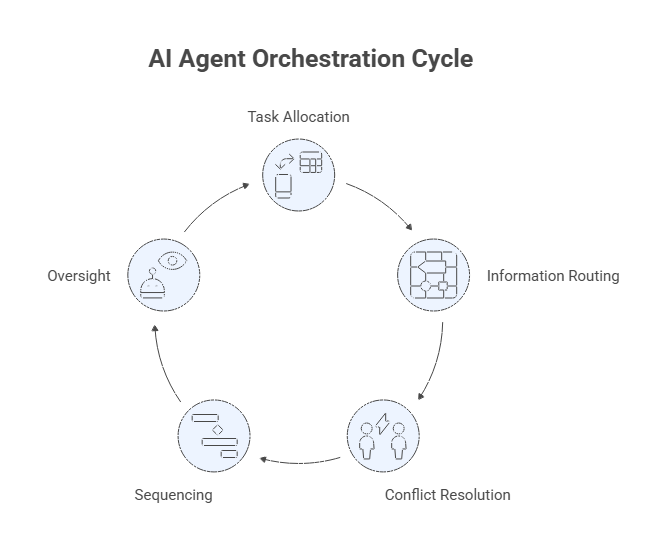
Orchestration is the coordination layer that manages how multiple AI agents work together toward shared objectives. It handles task allocation, information routing, conflict resolution, sequencing, and oversight across autonomously operating agent networks.
In practical terms, orchestration systems determine which agent handles which task, how outputs from one agent feed into another, what happens when agents produce conflicting results, and when human intervention is required. These decisions happen continuously as agents operate across complex, multi-step workflows.
Why Orchestration Becomes Critical at Scale
Organizations can manage a handful of independent agents without formal orchestration. Add more agents, more complex workflows, and higher-stakes decisions, and the absence of coordination creates problems that multiply faster than the benefits agents deliver.
1. Workflow Complexity
Real workflows span multiple interdependent tasks. Without orchestration, agents lack sequence awareness and dependency control, leading to misordered actions, delays, and operational errors.
2. Resource Conflicts
Agents competing for shared APIs, data, compute, or human input create contention. Orchestration prioritizes access, schedules execution, and prevents resource collisions before failures occur.
3. Error Propagation
Unvalidated outputs cascade through downstream agents, amplifying mistakes. Orchestration inserts checkpoints, validation, and retries to contain errors early and limit systemic impact.
4. Inconsistent Decisions
Independent agents may act on the same entity with conflicting outcomes. Orchestration maintains shared context and enforces coordination for consistent, unified decisions.
Core Functions of an Orchestration Layer
Effective orchestration handles several critical functions that agents cannot manage independently:
- Task Routing and Allocation: Orchestration assigns tasks to the most suitable agent using specialization, real-time load, and performance history, ensuring work matches capability rather than relying on inefficient self-selection.
- Context Management: Orchestration maintains shared state across agent interactions so every agent operates with full context, enabling seamless handoffs where downstream agents receive complete histories, not fragmented information.
- Dependency Management: Orchestration enforces task sequencing so prerequisite actions complete before execution proceeds, ensuring legal reviews, payments, and validations finish first while dependent processes trigger automatically and reliably.
- Exception Handling: Orchestration defines responses when agents fail, produce low-confidence outputs, or face unknown scenarios, routing exceptions to fallback agents or humans without stalling the overall workflow.
- Audit and Accountability: Orchestration records who made each decision, using what data and timing, creating auditable trails essential for compliance, debugging failures, governance, and continuous system improvement efforts.
Real-World Orchestration Examples
As organizations deploy multiple AI agents across core operations, orchestration becomes essential to ensure these agents act as a coordinated system rather than disconnected tools.
1. Healthcare Operations
AI in healthcare orchestrates agents for scheduling, insurance verification, pre-authorization, lab ordering, and care coordination. Orchestration synchronizes updates, triggers downstream actions automatically, and reduces administrative workload by over 40%.
2. Financial Services
Mortgage processing uses agents for income verification, credit analysis, fraud screening, valuation, and document generation. Orchestration sequences review, resolve conflicts, and escalate exceptions, reducing processing time by 60%.
3. E-commerce Fulfillment
Retailers orchestrate agents for inventory checks, payment processing, fraud screening, warehouse routing, and shipping confirmation. Orchestration enforces execution order, manages failures, and maintains order state, cutting processing time to seconds.
4. Customer Support Operations
Enterprises orchestrate agents for intent detection, issue diagnosis, resolution, retention, and escalation. Orchestration preserves context, avoids duplicate outreach, and improves first-contact resolution significantly.
5. Supply Chain & Logistics
Logistics firms orchestrate agents for demand forecasting, inventory planning, routing, carrier selection, and exception handling. Orchestration aligns decisions across stages, reducing delays, stockouts, and costly interventions.
Building Effective Orchestration Systems
Organizations implementing agent orchestration should consider several design principles:
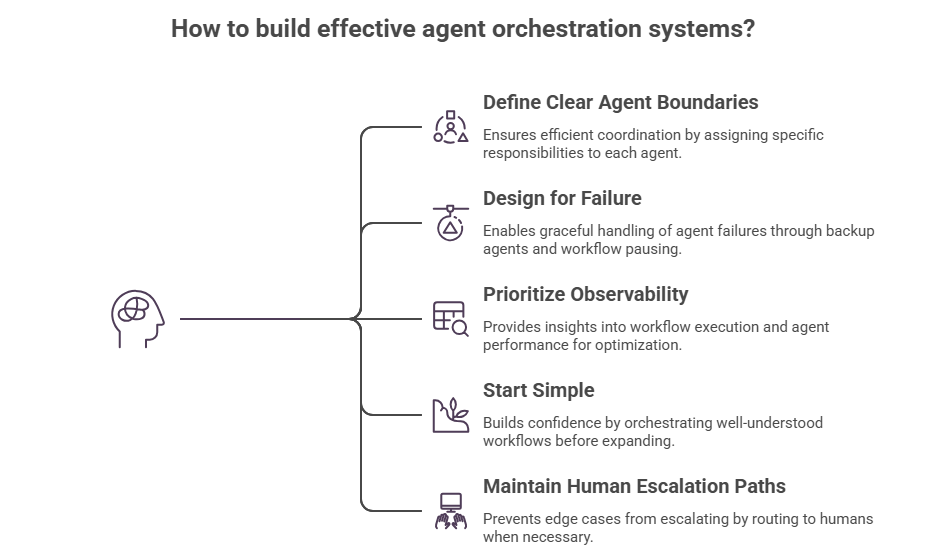
- Define Clear Agent Boundaries: Orchestration works best when each agent has well-defined responsibilities with minimal overlap. Ambiguity about which agent handles which situation creates coordination problems that orchestration cannot solve.
- Design for Failure: Autonomous systems fail in unexpected ways. Orchestration must handle agent failures gracefully, routing tasks to backup agents, pausing workflows when critical steps fail, and alerting humans when situations exceed automated handling capability.
- Prioritize Observability: Understanding what orchestration systems are doing requires comprehensive monitoring. Organizations need visibility into workflow execution, agent performance, bottlenecks, and decision patterns to optimize and troubleshoot effectively.
- Start Simple: Resist the temptation to orchestrate everything simultaneously. Begin with clear, well-understood workflows and expand orchestration scope as systems prove reliable. Complexity should grow incrementally with organizational confidence.
- Maintain Human Escalation Paths: Not every exception warrants automated handling. Clear criteria defining when orchestration routes to humans versus attempting automated resolution prevent edge cases from cascading into larger problems.
Also Read : AI Agent Observability Best Practices for Reliable and Compliant Systems
The Strategic Value
Organizations that implement robust orchestration unlock capabilities unavailable to those running isolated agents. Complex multi-step workflows become automatable. Specialized agents combine to handle sophisticated processes exceeding any individual agent’s capability. Human oversight scales across large agent populations through centralized monitoring rather than individual agent management.
Perhaps most importantly, orchestration creates organizational learning. Centralized coordination generates comprehensive data about process performance, agent capabilities, and workflow patterns. This data feeds continuous improvement cycles, making autonomous operations increasingly effective over time.
Also Read : AI Agents vs Automation: Key Differences & When to Use Each
Conclusion
AI agent orchestration is the core capability organizations must leverage to scale autonomous operations effectively. Without orchestration, expanding agent deployments increases complexity, decision conflicts, and operational risk rather than sustainable value.
By leveraging AI agent development services from partners like Amplework, organizations can design and utilize orchestrated agent systems with shared context, governed execution, and scalability, enabling reliable, enterprise-grade autonomous operations.
 sales@amplework.com
 (+91) 9636-962-228