
Why Most Enterprise GenAI Projects Stall After the POC Stage
Introduction
The potential of enterprise GenAI is undeniable. Initial proof-of-concept initiatives often demonstrate impressive results, garner executive attention, and engage key stakeholders. Yet, despite early promise, many POCs fail to progress. Weeks turn into months, and the project remains stalled, never reaching production. Industry data indicates that 85–90% of AI projects do not advance beyond the pilot stage, with enterprise GenAI initiatives particularly prone to this “POC purgatory.”
This blog examines the underlying reasons why promising GenAI projects stall after successful POCs and provides actionable strategies to overcome the barriers that separate proof-of-concept from full-scale production deployment.
The Enterprise GenAI POC Success Paradox
Enterprise Generative AI POCs often succeed spectacularly in controlled environments. A chatbot handles test queries flawlessly. A document processor achieves 95% accuracy on sample files. Content generation produces impressive results. Stakeholders approve enthusiastically.
Yet nine months later, the POC hasn’t advanced. What happened?
The Hidden Truth: POC success doesn’t guarantee production readiness. Demonstrating technical feasibility differs fundamentally from building production-grade systems handling real-world complexity, scale, security requirements, and organizational constraints.
Why Enterprise GenAI Projects Stall: The Real Obstacles
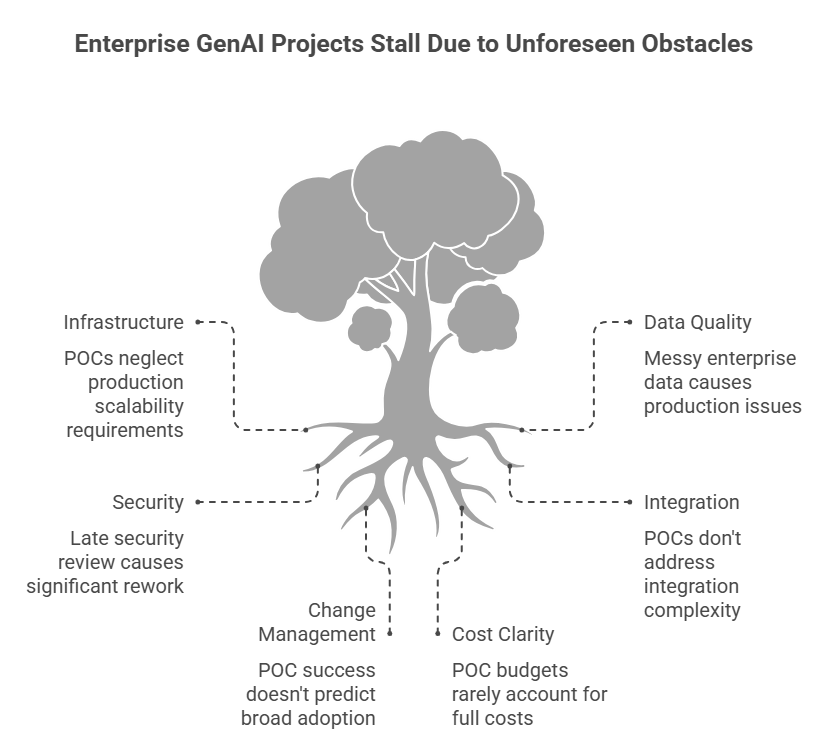
1. Infrastructure and Scalability Challenges
The POC Reality: Testing with 100 documents or 50 users in controlled environments works perfectly.
The Production Reality: Handling 100,000 documents daily, supporting thousands of concurrent users, and maintaining sub-second response times requires entirely different infrastructure.
The Gap: POCs rarely address scalability requirements. Moving to production reveals infrastructure inadequacies, insufficient compute resources, API rate limits, latency issues, and integration bottlenecks requiring substantial additional investment.
Solution: Plan production infrastructure during the POC phase. Test at realistic scales, even if simulated, to validate architecture before stakeholder commitment.
2. Data Quality and Governance Issues
The POC Reality: Curated sample datasets cleaned specifically for testing.
The Production Reality: Messy, incomplete, inconsistent enterprise data across systems with varying formats, quality levels, and access restrictions.
The Gap: Production GenAI projects encounter data quality issues absent from POC environments. Missing fields, format inconsistencies, outdated information, and integration challenges emerge when processing real enterprise data.
Solution: Use production data samples during POC, even if limited. Identify data quality issues early and address governance requirements upfront.
3. Security and Compliance Barriers
The POC Reality: Minimal security review, temporary exemptions, sandbox environments without regulatory oversight.
The Production Reality: Comprehensive security assessments, compliance validation (SOC 2, HIPAA, GDPR), penetration testing, and regulatory approval are required before production deployment.
The Gap: Security and compliance teams engage late, discovering requirements that POC architecture can’t satisfy without significant rework.
Solution: Involve security and compliance stakeholders from POC inception. Design with production security requirements, not as an afterthought.
4. Integration Complexity
The POC Reality: Standalone demo or minimal integration with one or two systems using test APIs.
The Production Reality: Integration with dozens of enterprise systems, CRM, ERP, data warehouses, authentication services, and monitoring tools, each with unique protocols, authentication requirements, and data formats.
The Gap: POC validates AI capabilities but doesn’t address integration complexity, consuming 40-60% of production implementation effort.
Solution: Focus on essential integrations during the POC to identify challenges early. Leveraging AI integration services ensures seamless deployment to enterprise systems.
5. Change Management and User Adoption
The POC Reality: Enthusiastic early adopters testing voluntarily in controlled scenarios.
The Production Reality: Diverse user populations with varying technical literacy, resistance to workflow changes, and skepticism about AI reliability.
The Gap: POC success with motivated testers doesn’t predict broad organizational adoption. Production deployment faces change management challenges that POC never addressed.
Solution: Involve actual end users during POC. Test with skeptics, not just enthusiasts. Gather feedback on workflow integration, not just technical performance.
6. Cost and ROI Clarity
The POC Reality: Limited budget for time-boxed experiment with undefined long-term costs.
The Production Reality: Ongoing infrastructure expenses, API costs scaling with usage, maintenance requirements, and ROI pressure demanding clear business value.
The Gap: POC budgets rarely account for full production costs. When ongoing expenses for LLM APIs, infrastructure, and operational support become clear, stakeholders often question ROI if a detailed business case has not been established.
Solution: Project realistic production costs during POC. Calculate ROI based on actual usage patterns, not demo scenarios.
From POC to Production: Best Practices
- Establish Clear Production Requirements: Define benchmarks, security, integration, and cost constraints upfront; success is measured by production readiness, not demos.
- Treat POCs as Production MVPs: Design POCs as scalable MVPs, anticipating architecture, security, and integration needs for full deployment.
- Gain Executive Commitment: Ensure leadership understands POCs are initial steps, requiring continued investment for production success.
- Implement Phased Rollouts: Deploy gradually, start with one department, then scale to divisions, reducing risk while proving business value.
- Form Cross-Functional Teams: Include engineering, security, compliance, operations, and business stakeholders from POC inception for success.
- Track Business Outcomes: Measure metrics stakeholders value, including cost savings, efficiency, revenue impact, not just technical performance.
Also Read : Generative AI PoC Services in 2026: What You Can Build, Use Cases & Cost Breakdown
Conclusion
Enterprise GenAI POC success is necessary but not sufficient. A Gartner study shows most projects fail due to underestimated production complexity, inadequate planning, and treating POCs as endpoints rather than beginnings.
Amplework, focused on enterprise solutions, enables organizations to transition GenAI initiatives from POC to production with architecture, integration, and scalable AI workflows.
 sales@amplework.com
 (+91) 9636-962-228