

Levels of AI Models: Understanding Model Complexity in Modern AI Systems
Introduction
Not all AI is created equal. Levels of AI models vary dramatically in capability, complexity, and computational requirements, from simple rule-based systems to sophisticated neural networks processing billions of parameters. Understanding AI model complexity helps businesses select appropriate solutions, budget accurately, and set realistic expectations for what AI can accomplish.
This guide breaks down the types of AI models across complexity levels, explaining how modern AI systems work and when each level makes sense for specific business applications. Whether you’re evaluating AI solutions or planning implementations, understanding AI models at different complexity levels is essential for success.
Why AI Model Complexity Matters
Choosing the wrong complexity level leads to common problems:
Over-Engineering: Deploying a billion-parameter LLM when simple classification would suffice wastes resources and introduces unnecessary complexity. A retailer using GPT-4 for basic sentiment analysis spends 100x more than needed.
Under-Engineering: Applying simple models to complex problems guarantees poor results. Rule-based chatbots handling nuanced customer service queries frustrate users with rigid responses.
Budget Misalignment: Complex models require substantial computing resources, training costs, inference infrastructure, and ongoing maintenance. Understanding complexity helps match solutions to budgets.
The key is matching model complexity to problem complexity, balancing performance requirements with cost, speed, and maintainability.
Level 1: Rule-Based Systems
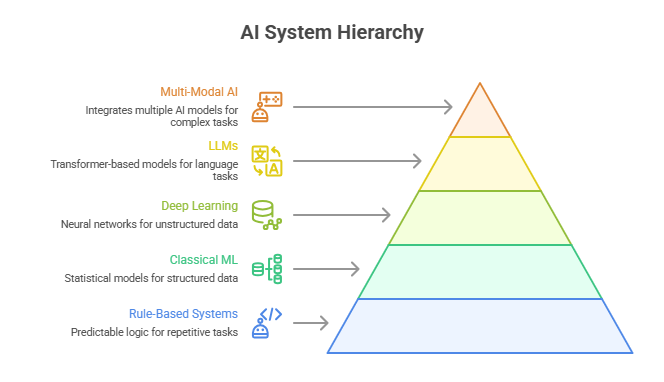
Rule-based AI uses explicit if-then logic programmed by developers. It is predictable, fully controllable, and suitable for repetitive tasks with clearly defined rules and minimal variation.
Advantages:
- Fully explainable and easy to understand for non-technical users
- No historical data or training required
- Immediate and fast execution
- Ideal for simple, repetitive automation
- Easy to monitor and adjust rules manually
Limitations:
- Cannot handle unexpected inputs or novel situations
- Requires constant manual updates to stay relevant
- Very brittle; one error can break the system
- Lacks learning or adaptability
- Limited scalability for complex workflows
Level 2: Classical Machine Learning
Classical ML uses statistical models to learn patterns from labeled data. Effective for structured datasets, these models help with predictions, classifications, and decision-making within defined problem spaces.
Advantages:
- Well-understood algorithms with interpretable outputs
- Efficient for structured data problems
- Works well for predictive analytics and recommendations
- Flexible to adapt to new labeled data
- Relatively low computational requirements compared to deep learning
Limitations:
- Requires high-quality labeled datasets
- Needs careful feature engineering for optimal performance
- Struggles with unstructured data like images or text
- Limited in handling complex, multi-step decision processes
- Can overfit if not properly validated
Level 3: Deep Learning
Deep learning uses neural networks with multiple layers to automatically learn hierarchical features from large datasets. Best suited for unstructured data such as images, text, audio, and complex pattern recognition.
Advantages:
- Excels at analyzing unstructured data such as images and audio
- Automatically learns complex patterns without manual feature engineering
- State-of-the-art performance in vision, speech, and NLP tasks
- Scales effectively with larger datasets
- Can capture subtle relationships within complex data
Limitations:
- Requires large datasets and significant computational resources
- Models are often “black boxes,” reducing interpretability
- Risk of overfitting on small datasets
- Training can be time-consuming and expensive
- Harder to debug or troubleshoot compared to classical ML
Level 4: Large Language Models
Large language models (LLMs) are transformer-based AI trained on massive text corpora. They understand, generate, and reason with natural language, enabling conversational AI, content creation, and advanced reasoning tasks.
Advantages:
- Excellent understanding of human language and context
- Few-shot or zero-shot learning capabilities
- Can perform multiple language tasks: summarization, translation, and content generation
- Adapts quickly to diverse domains with fine-tuning
- Reduces human effort in writing, research, and customer support
Limitations:
- Expensive to train and operate at scale
- May produce hallucinations or incorrect information
- Requires careful prompt engineering for accuracy
- High latency for complex queries
- Resource-intensive in memory and processing
Level 5: Multi-Modal & Agentic Systems
Multi-modal AI integrates text, vision, and audio models with reasoning and tool usage. These systems can execute multi-step workflows autonomously, interact with external systems, and adapt across complex domains.
Advantages:
- Handles complex, open-ended tasks across multiple domains
- Integrates different data types seamlessly (text, image, audio)
- Learns and improves from interactions and feedback
- Enables autonomous decision-making and multi-step task execution
- Flexible and capable of orchestrating multiple AI tools simultaneously
Limitations:
- Extremely costly to implement and maintain
- Requires sophisticated infrastructure and orchestration layers
- High complexity makes debugging and monitoring difficult
- Needs multiple specialized datasets and reinforcement learning
- Maintenance and updates are continuous and resource-intensive
AI Models Comparison
To simplify understanding AI model complexity, this table summarizes each level’s characteristics, training needs, typical applications, and practical examples. It provides a clear snapshot for businesses to compare and choose the right AI approach.
Choosing the Right Complexity Level
- Start Simple: Begin with the least complex model that could plausibly work. Many problems don’t require deep learning or LLMs.
- Scale Based on Results: If simpler models underperform, incrementally increase complexity rather than jumping to the most sophisticated solution.
- Consider Total Cost: Include not just AI model development but ongoing inference costs, maintenance, monitoring, and retraining.
- Match to Data Availability: More complex models require more data. Don’t choose deep learning with only 1,000 training examples.
- Factor in Explainability: Regulated industries often require model interpretability, favoring simpler approaches even if complex models perform slightly better.
Also Read : A Guide to Know All About AI Models
Conclusion
Understanding levels of AI models and AI model complexity enables smarter technology decisions. Modern AI systems span from simple rule-based logic to sophisticated multi-modal agents, each with distinct capabilities, costs, and appropriate use cases.
The goal isn’t always the most advanced AI; it’s the right AI for your specific problem, budget, and constraints. Many successful applications combine multiple AI models at different levels. Amplework delivers AI/ML solutions tailored to business needs, ensuring practical impact and measurable results.
Whether you’re implementing your first AI system or optimizing existing ones, understanding AI models across complexity levels helps you invest wisely, set realistic expectations, and achieve measurable business value.
 sales@amplework.com
 (+91) 9636-962-228