

Practical Guide: How AI Models Work Behind the Scenes (For Business Decision Makers)
You’ve heard AI can transform your business, but what actually happens when an AI model makes a prediction? Understanding how AI models work doesn’t require a PhD in computer science, just clarity on the fundamental process driving this technology.
Global AI adoption has reached 72% among organizations (McKinsey, 2024), yet many decision-makers approve AI budgets without grasping what they’re actually building. This knowledge gap leads to unrealistic expectations and failed implementations.
How Do AI Models Work: The Core Process
AI models are mathematical systems that learn patterns from data to make predictions or decisions. Think of them as sophisticated pattern-recognition engines trained on examples rather than programmed with explicit rules.
The process follows four fundamental stages:
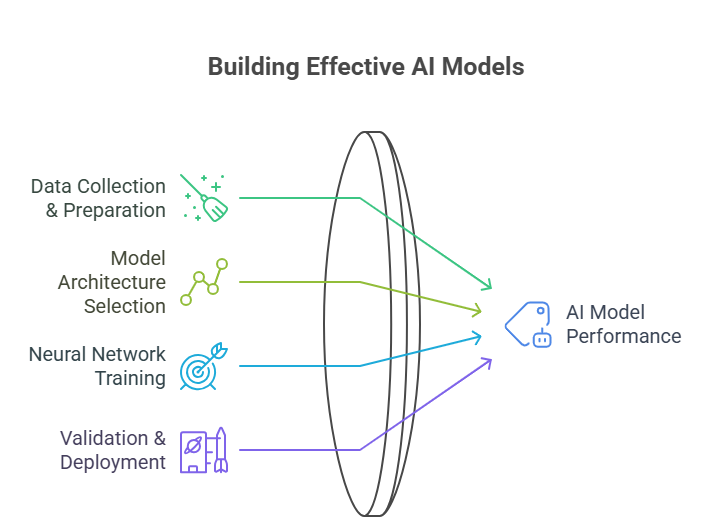
1. Data Collection & Preparation
AI models rely on substantial, well-prepared training data that maps inputs to desired outputs, such as historical customer activity paired with churn outcomes. Quality matters more than quantity, so teams spend most of their time cleaning errors, fixing missing values, and ensuring data consistency to improve overall model performance.
2. Model Architecture Selection
AI model architecture refers to the mathematical structure that processes your data. Different architectures suit different problems:
- Traditional Machine Learning: Best for structured data and offers easy-to-interpret models with lower data requirements.
- Neural Networks: Handle complex patterns in images, text, and audio by learning relationships across multiple layers.
- Deep Learning: Uses deep multi-layer networks to automatically extract features for tasks like vision, language, and speech.
3. Neural Network Training
Training is the stage where models learn from data. The process works like this:
- Initialization: The model begins with random weights that lead to poor predictions.
- Forward Pass: Data moves through the network to generate outputs.
- Error Calculation: Predictions are compared with actual results to measure mistakes.
- Backpropagation: The model adjusts its weights to reduce those errors.
- Iteration: This cycle repeats thousands of times until accuracy steadily improves.
It’s similar to practicing darts, each attempt provides feedback that helps refine performance over time.
4. Validation & Deployment
Before deployment, models are tested on unseen data to check real world performance. Key validation metrics include:
- Accuracy: Correct predictions
- Precision: Correct positive predictions
- Recall: Captured actual positives
- F1 Score: Balance of precision and recall
Models meeting required thresholds move to production and handle live data effectively.
What Happens When AI Models Make Predictions?
In production, new data enters the trained model, flows through its learned mathematical structure, and produces outputsclassifications, predictions, or recommendations, typically in milliseconds.
For example, when a customer contacts support, a trained model instantly analyzes their history, current issue, and behavioral patterns to predict churn risk and recommend retention actions.
Why Some AI Models Fail
Understanding how AI models work also reveals common failure points:
- Insufficient Training Data: Models need hundreds or thousands of examples to learn reliably. Sparse data produces unreliable predictions.
- Data Drift: Business conditions change over time. Models trained on 2022 data may perform poorly in 2024 without retraining.
- Poor Feature Selection: Models need relevant input variables. Irrelevant features introduce noise that degrades performance.
Business Implications for Decision Makers
- AI Requires Strong Data Foundations: You need reliable systems to collect, store, and access high-quality data. This groundwork often determines overall project success.
- Results Take Time: Model development, training, and validation typically take weeks or months, so set realistic expectations.
- Models Need Ongoing Care: AI systems require continuous monitoring, retraining, and updates as business needs change, supported by proper AI model training services.
- Interpretability Is Important: In regulated or high-risk environments, choose models that clearly explain their decisions, even if accuracy slightly decreases.
Also Read : Top Machine Learning Models Powering AI Innovations
Making Informed AI Investment Decisions
Understanding how AI models work empowers better strategic decisions. You’ll ask the right questions about data requirements, timelines, and performance expectations, avoiding costly assumptions. As a leading provider of AI strategy consulting, Amplework Software guides decision makers with clear technical explanations, realistic project scoping, and methodologies that deliver measurable business outcomes.
Bottom line
AI models learn patterns from data through iterative training processes, then apply learned knowledge to make predictions. Success depends on quality data, appropriate architecture selection, rigorous validation, and ongoing maintenance, not magic, but disciplined engineering.
 sales@amplework.com
 (+91) 9636-962-228