
Generative AI in Medical Coding: Applications, Limitations, and Learning Benefits for Coders
Introduction
Generative AI in coding is revolutionizing healthcare revenue cycle management, with medical coding emerging as a prime application area. The global healthcare AI market is projected to exceed $188 billion by 2030, with coding automation representing a significant segment. Understanding AI applications in medical coding and AI learning benefits for coders helps healthcare organizations and professionals navigate this transformation effectively.
This guide explores how generative AI transforms medical coding workflows, its practical limitations, and how coders can leverage AI as a learning and productivity tool rather than viewing it as a replacement threat.
Applications of Generative AI in Medical Coding
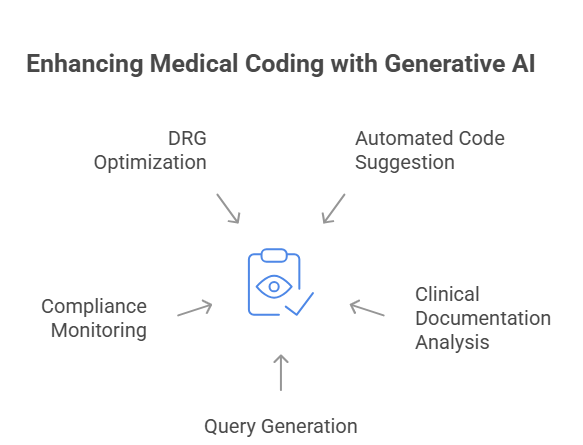
Generative AI in medical coding delivers tangible improvements across the coding workflow:
1. Automated Code Suggestion
AI analyzes clinical documentation, physician notes, lab results, procedure reports, and suggests appropriate ICD-10, CPT, and HCPCS codes. Unlike simple keyword matching, generative AI solutions understand medical context and relationships between diagnoses and procedures.
Impact: Reduces initial code assignment time by 40-60%, allowing coders to review more charts daily while maintaining accuracy.
2. Clinical Documentation Analysis
AI extracts relevant information from unstructured clinical notes, identifying diagnoses, procedures, medications, and complications that support code assignments. It flags potential missed codes and documentation gaps that could lead to undercoding or denials.
Impact: Increases code capture by 15-25%, improving revenue while ensuring compliant coding.
3. Query Generation
When documentation is ambiguous or incomplete, AI automatically generates clinical queries for physicians, asking specific questions to clarify diagnoses, severity, or procedure details necessary for accurate coding.
Impact: Reduces query turnaround time by 50-70%, accelerating billing cycles.
4. Compliance Monitoring
AI coding tools continuously check for coding errors, inconsistent code combinations, medical necessity issues, and potential compliance risks before claims are submitted.
Impact: Reduces claim denials by 20-35% and minimizes audit risks.
5. DRG Optimization
For inpatient coding, AI identifies opportunities to capture more specific diagnoses and complications that impact DRG assignment and reimbursement while maintaining coding accuracy and compliance.
Impact: Increases case mix index (CMI) by 3-8% through improved documentation and coding specificity.
Limitations of Generative AI in Medical Coding
Despite impressive capabilities, understanding the limitations of generative AI is crucial for realistic implementation:
1. Context Understanding Gaps
AI struggles with nuanced clinical scenarios requiring deep medical knowledge. Complex cases involving multiple comorbidities, unusual presentations, or conflicting documentation require human judgment.
2. Hallucination Risk
Generative AI can confidently suggest incorrect codes or “hallucinate” information not present in documentation. Without human verification, this leads to compliance violations and denials.
3. Regulation and Compliance Requirements
Healthcare coding operates under strict regulatory frameworks (HIPAA, AMA guidelines, CMS regulations). AI must be carefully validated to ensure compliance, and ultimate responsibility remains with certified human coders.
4. Training Data Limitations
AI performance depends on training data quality. Models trained on outdated guidelines, specialty-specific documentation patterns, or limited clinical scenarios may provide suboptimal suggestions.
5. Integration Complexity
Implementing applications of generative AI in medical coding requires integration with EHR systems, billing software, and existing workflows. Technical challenges and change management can slow adoption.
Also Read : Choosing the Right AI Integration Platform: iPaaS, Custom Middleware, or Native AI?
AI Learning Benefits for Coders
AI learning for coders represents generative AI’s most underappreciated benefit, transforming it from a threat into a professional development tool:
Real Time Education
- AI explains code suggestions with rationale, guideline references, and clinical logic, helping junior coders learn faster and reducing training time by 30 to 40 percent.
Pattern Recognition Training
- By observing how AI analyzes documentation patterns, coders improve clinical reasoning and become better at identifying missed or incomplete documentation within 3 to 6 months.
Guideline Updates Awareness
- AI highlights new codes, revised definitions, and updated conventions during daily work, reducing the need for manual guideline research.
Specialized Knowledge Expansion
- Exposure to multiple specialties through AI expands medical terminology and procedural knowledge, increasing career opportunities and compensation potential.
Quality Improvement Feedback
- AI analyzes coder performance to identify accuracy gaps, commonly missed codes, and documentation issues, providing personalized development insights.
The Future: Augmented Coders, Not Replaced Coders
The most successful healthcare organizations view generative AI in coding as coder augmentation, not replacement. AI handles high-volume, straightforward cases while human coders focus on complex scenarios, quality assurance, compliance oversight, and continuous improvement.
Evolving Role: Medical coders are transitioning into roles as coding analysts and quality specialists in AI in healthcare settings, where they use AI to increase throughput while applying expert judgment to ensure accuracy, regulatory compliance, and optimal reimbursement.
Skills for the AI Era: Successful coders develop AI literacy, understanding AI capabilities and limitations, effectively reviewing AI suggestions, training AI systems with feedback, and focusing on complex case expertise.
Also Read : The Hidden Costs of AI Integration: Infrastructure, Ops, and Organizational Drag
Conclusion
AI applications in medical coding deliver measurable improvements: 40-60% faster coding, 15-25% improved code capture, and 20-35% fewer denials. However, limitations of generative AI require continued human oversight, medical judgment, and compliance responsibility.
For organizations adopting generative AI in medical coding, Amplework delivers advanced AI model development that enhances learning, expands coder expertise, improves accuracy, and positions AI as a productivity enabler rather than a replacement.
 sales@amplework.com
 (+91) 9636-962-228