
AI Proof of Concept Explained: Meaning, Key Steps, Benefits & Real-World Examples
Introduction
Many companies invest in AI only to realize months later that it does not deliver the expected value. AI Proof of Concept (PoC) projects solve this problem by validating whether an AI solution can work in real-world business conditions before committing significant resources. A well-executed PoC reduces risk, aligns stakeholders, and provides clear evidence of potential ROI.
This guide explains what an AI PoC is, why it matters, how to execute one successfully, and examples showing measurable business outcomes.
What Is an AI Proof of Concept?
An AI PoC is a small-scale experiment designed to answer a critical question: Will this AI solution actually solve your business problem? Unlike full-scale implementations, an AI PoC typically runs for 4–12 weeks, using limited data and resources. Its goal is to validate technical feasibility, demonstrate business impact, and uncover integration or operational challenges before larger investments are made.
Why Organizations Need AI PoCs
AI projects often fail when organizations move forward without proper validation. Proof of Concept (PoC) projects help reduce this risk by testing data quality, technical feasibility, and system integration early, before significant resources are committed. They provide tangible results that align stakeholders, build confidence, and guide informed investment decisions.
Beyond technical validation, PoCs quantify business value by estimating ROI and efficiency gains, while helping teams understand how AI fits into existing workflows and identify potential operational challenges. They also allow organizations to evaluate vendors based on actual performance rather than promises. In short, a PoC is not just a technical exercise; it is a strategic decision-making tool that informs smarter AI investments.
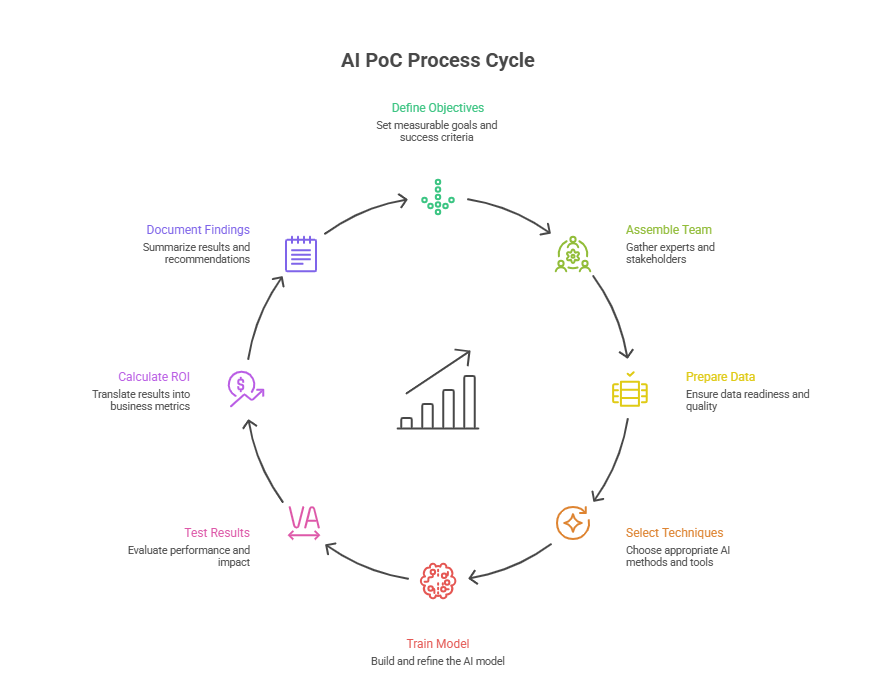
The AI PoC Process: 8 Key Steps
1. Define Objectives and Success Criteria
Specify measurable goals and expected business impact. Example: Classify customer support tickets with 85% accuracy, reducing manual routing time by 60% and saving $200,000 annually.
2. Assemble the Right Team
Include domain experts, data scientists, engineers, IT specialists, and business stakeholders. Smaller organizations can leverage external AI partners with end-to-end expertise.
3. Assess and Prepare Data
Data readiness determines PoC outcomes. Evaluate volume, quality, labeling, compliance, and access. Prepare representative datasets that allow rapid testing without compromising reliability.
4. Select AI Techniques and Tools
Match AI methods to the business problem and data type. Use proven frameworks and pre-trained models rather than building everything from scratch.
5. Develop and Train the Model
Build iteratively, starting simple and tracking performance continuously. Focus on validating core capabilities through AI model training, not achieving perfection.
6. Test and Evaluate Results
Assess technical performance, business impact, integration readiness, and user acceptance. Document lessons learned, including failures that inform future decisions.
7. Calculate ROI and Business Impact
Translate technical results into business metrics: cost savings, revenue potential, efficiency improvements, and risk reduction. Include both conservative estimates and projections for full deployment.
8. Document Findings and Recommendations
Provide a clear summary of objectives, results, business impact, and next steps. Recommend whether to proceed, pivot, or stop, along with a roadmap for scaling successful solutions.
Benefits of AI PoCs
Investing in a PoC provides several advantages:
- Faster Time to Value: Identify the most effective approaches early, accelerating AI deployment and delivering measurable results quickly.
- Resource Optimization: Focus budgets, personnel, and efforts on initiatives that demonstrate real potential and proven feasibility.
- Reduced Implementation Risk: Detect technical, data, and integration challenges early to prevent costly failures later on.
- Enhanced Stakeholder Confidence: Provide tangible results that build trust and support for AI initiatives across the organization.
- Knowledge Building: Equip teams with practical AI experience, improving skills and readiness for future AI projects.
- Strategic Clarity: Guide AI strategy, prioritize investments, and ensure evidence-based decisions for maximum business impact.
Real‑World AI PoC Examples
1. Retail: Walmart Inventory Optimization
Walmart used predictive analytics in PoC mode to refine inventory planning across thousands of stores, reducing out‑of‑stock rates and lowering inventory costs.
2. Healthcare: Bupa APAC Diagnostic Acceleration
Bupa APAC ran an AI PoC on pathology scans that cut analysis time by ~50%, boosting clinician productivity and improving diagnosis accuracy before scaling broader AI healthcare services.
3. Manufacturing: Siemens Predictive Maintenance Integration
Siemens leveraged an AI PoC for real‑time predictive maintenance sensors, helping maintenance teams shift from reactive repairs to proactive operations before enterprise roll‑out.
4. Logistics: AI Shipment Forecasting
A major logistics provider tested AI for delay forecasting using weather and route data, improving route planning and cutting customer complaints before full deployment.
5. Financial Services: JPMorgan Chase Risk & Legal AI
JPMorgan’s AI PoC, including the COiN tool, automated massive legal and risk analyses, saving hundreds of thousands of manual hours, supporting broader AI risk operations.
Also Read : AI Proof of Concept Use Cases: Practical Business Examples Across Industries
Why Amplework is the Right Partner
Amplework delivers reliable, scalable AI and ML solutions tailored to your business needs. Our team provides full-stack expertise, flexible staffing, transparent communication, and proven quality. We help startups and enterprises achieve cost-effective, high-impact AI implementations while providing ongoing support. With experience across multiple industries and AI domains, Amplework ensures your AI PoC delivers actionable insights and measurable results that inform confident scaling decisions.
Conclusion
AI Proof of Concept projects are strategic tools, not experiments. They reduce risk, accelerate value, and give businesses clear evidence to make informed decisions. By following a structured PoC process and partnering with an experienced provider, organizations can turn AI ideas into measurable business impact and scale initiatives with confidence.
 sales@amplework.com
 (+91) 9636-962-228