

AI Business Context Refinement: Methods & Examples
Introduction
Generic AI models provide generic results. Business context refinement AI transforms standard algorithms into powerful tools that understand your specific industry, terminology, workflows, and objectives. While off-the-shelf AI might achieve 60% accuracy on your tasks, properly refined contextual AI can reach 85-95%, the difference between disappointing results and transformative business value.
This guide explores practical methods for AI context optimization, demonstrates AI contextual learning approaches, and provides real-world examples showing how context refinement turns AI from “interesting technology” into “indispensable tool.”
What Is Business Context Refinement?
Business context refinement AI is the process of adapting AI systems to understand and operate within your specific business environment, incorporating domain knowledge, company-specific terminology, operational workflows, success metrics, and unique challenges that generic models don’t comprehend.
Core Elements:
- Domain Expertise: Industry-specific knowledge (financial regulations, medical terminology, retail seasonality)
- Company Knowledge: Internal processes, product catalogs, customer segments, organizational structure
- Operational Context: Workflow integration points, decision-making criteria, approval processes
- Performance Metrics: Your specific KPIs, success definitions, and business priorities
Context refinement ensures AI speaks your language, understands your constraints, and optimizes for your objectives rather than generic benchmarks.
Why Context Refinement Matters
Business context refinement AI matters because generic AI trained on public data often struggles with specialized terminology and business-specific scenarios. By teaching AI your domain nuances, task accuracy can improve by 25–40%. Recommendations aligned with the business context become actionable rather than theoretical, ensuring practical relevance. Systems that understand your workflows integrate seamlessly, reducing friction and increasing employee adoption, as users trust AI that “gets it.” Moreover, while competitors rely on generic AI, business context refinement AI provides unique capabilities that cannot be replicated with off-the-shelf solutions, creating a clear competitive advantage.
Methods for AI Context Optimization
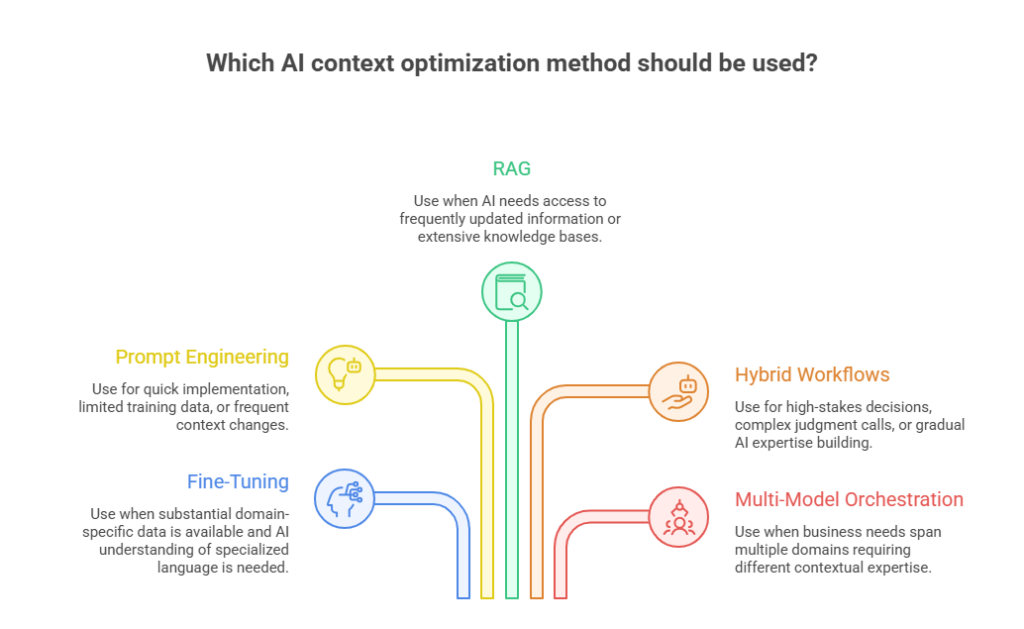
1. Fine-Tuning with Domain Data
Approach: Continue training pre-trained models on your specific business data, teaching them your terminology, patterns, and decision-making.
Example: A healthcare provider fine-tunes a language model on 50,000 internal clinical notes, enabling it to understand their specific documentation patterns, abbreviations, and clinical workflows. Result: 45% improvement in automated coding accuracy.
When to Use: When you have substantial domain-specific data (thousands to hundreds of thousands of examples) and need AI understanding of specialized language or patterns.
2. Prompt Engineering and Instruction Tuning
Approach: Crafting detailed prompts providing context, examples, and constraints guiding AI behavior without retraining models.
Example: A legal firm develops prompt templates instructing AI on their contract review standards: “Review this vendor agreement focusing on liability clauses, payment terms, and termination rights. Flag any terms exceeding our standard risk thresholds [defined parameters].” Result: 60% faster contract review with 90% accuracy.
When to Use: For quick implementation, when training data is limited, or when context changes frequently requiring flexibility.
3. Retrieval-Augmented Generation (RAG)
Approach: Augmenting AI with real-time access to your knowledge base—documents, databases, policies, enabling contextually grounded responses using your specific information.
Example: Customer service AI uses RAG to dynamically retrieve product manuals, warranty policies, and troubleshooting guides when responding to inquiries. Result: 70% autonomous resolution rate versus 35% for generic chatbots.
When to Use: When AI needs access to frequently updated information, extensive knowledge bases, or company-specific documentation.
4. Hybrid Human-AI Workflows
Approach: Designing processes where AI handles context-dependent tasks with human oversight, creating feedback loops that continuously refine AI understanding.
Example: Investment firm uses AI to screen potential deals based on their investment criteria, with analysts reviewing flagged opportunities and providing feedback to refine AI’s understanding of “good fit.” Result: 80% reduction in analyst screening time while maintaining deal quality.
When to Use: For high-stakes decisions, complex judgment calls, or when building AI expertise gradually through human feedback.
5. Multi-Model Orchestration
Approach: Combining specialized AI models, each expert in specific contexts, with an orchestration layer routing tasks appropriately based on business context.
Example: E-commerce platform uses separate models for product search (retail context), fraud detection (security context), and personalization (customer context), with an orchestrator determining which models engage based on user interaction type. Result: 35% improvement in customer experience metrics.
When to Use: When a business needs span multiple domains requiring different contextual expertise.
Real-World Context Refinement Examples
- Manufacturing: Generic anomaly detection flagged many false positives. Context refinement using machine specs, operational parameters, and maintenance history reduced false alarms by 65% and caught 95% of real issues.
- Financial Services: Standard credit models missed small business nuances. Refinement with industry metrics, seasonal trends, and regional factors improved approval accuracy by 40% and expanded qualified borrower access.
- Healthcare: Generic AI suggested treatments without considering formulary, insurance, or patient history. Context refinement improved relevance and increased physician adoption from 30% to 78%.
- Logistics: Standard AI ignored traffic and vehicle constraints. Context refinement with delivery schedules, vehicle types, and weather reduced delivery times by 18% and fuel costs by 12%.
- Education: Standard AI learning platforms struggled to personalize content. Context refinement using learning styles, curriculum, and performance history increased engagement by 40% and improved outcomes.
Also Read : AI Business-Specific Context: Meaning & How It Works
Implementation Best Practices
- Start with a Clear Context Definition: Document exactly what contextual knowledge AI needs, including terminology, processes, constraints, and success metrics to guide refinement effectively.
- Measure Baseline Performance: Evaluate generic AI first to establish benchmarks. This helps quantify improvements from context refinement and identify key areas for optimization.
- Iterate Based on Feedback: Continuously incorporate user feedback, real-world scenarios, and edge cases to improve AI understanding and ensure ongoing relevance.
- Balance Depth and Flexibility: Avoid over-specialization. Maintain enough generality for novel situations while optimizing for common business contexts to maximize adaptability.
- Prioritize High-Impact Use Cases: Focus refinement efforts on areas with the greatest business value, such as decision-critical processes, customer-facing applications, or high-volume tasks.
- Integrate Monitoring and Analytics: Implement performance tracking to detect drift, assess accuracy, and optimize contextual AI models over time, ensuring sustained effectiveness and ROI.
Also Read : AI Business Context Validation: What It Is & Why It Matters
Conclusion
Business context refinement AI transforms generic algorithms into business-specific tools, delivering 25–40% accuracy improvements and significantly higher user adoption. Through AI context optimization techniques, fine-tuning, prompt engineering, RAG, human-AI workflows, and multi-model orchestration, organizations create AI systems that truly understand their unique environments.
The most powerful AI isn’t the most sophisticated algorithm; it’s the one that understands your business context deeply enough to deliver results no generic system can match. Partnering with Amplework, businesses can implement these custom AI solutions efficiently, leveraging expert guidance to build contextually refined systems that drive measurable impact and competitive advantage.
 sales@amplework.com
 (+91) 9636-962-228