

What Is an AI Model? Clear Definition, Components, and Real Business Use Cases
Introduction
Artificial Intelligence is transforming how businesses operate, but understanding the technology behind it starts with one fundamental question: what is an AI model? Whether you’re exploring AI in business for the first time or evaluating enterprise AI applications, grasping this concept is crucial for making informed decisions about AI adoption.
An AI model definition goes beyond technical jargon; it’s about understanding how machines learn patterns, make predictions, and drive business value. This guide breaks down AI model components, explores different types of AI models, and showcases real-world business use cases that demonstrate tangible ROI.
What Is an AI Model? A Clear Definition
An AI model is a program or algorithm trained on data to recognize patterns, make decisions, and perform specific tasks without explicit programming for each scenario. Think of it as a digital brain that learns from experience rather than following rigid, pre-written rules.
The AI model definition encompasses three core elements:
- Training Data: The information used to teach the model patterns.
- Learning Algorithm: The mathematical framework that processes data and identifies patterns.
- Prediction/Output Mechanism: The ability to apply learned patterns to new, unseen data.
Unlike traditional software that follows “if-then” rules, AI models improve through exposure to data, making them ideal for complex, evolving business challenges.
Key Components of AI Models
Understanding AI model components helps businesses evaluate and implement the right enterprise solutions:
1. Data Layer: High-quality, relevant datasets that represent the problem you’re solving. Poor data quality leads to poor model performance, a principle known as “garbage in, garbage out.”
2. Algorithm: The mathematical engine (neural networks, decision trees, support vector machines, etc.) that learns patterns from data. Different algorithms suit different business problems.
3. Parameters and Weights: Internal values adjusted during training to optimize model accuracy. These determine how the model interprets input data.
4. Training Infrastructure: Computing resources (CPUs, GPUs, cloud platforms) required to process large datasets and train models effectively.
5. Evaluation Metrics: Measurements like accuracy, precision, and recall that assess how well the model performs against business objectives.
Types of AI Models for Business Applications
Different types of AI models address distinct business needs:
1. Supervised Learning Models: Trained on labeled data to predict specific outcomes. Common in fraud detection, customer churn prediction, and sales forecasting. They excel when you have historical data with known results.
2. Unsupervised Learning Models: Discover hidden patterns in unlabeled data. Ideal for customer segmentation, anomaly detection, and market basket analysis, where you’re exploring unknown connections.
3. Reinforcement Learning Models: Learn through trial and error, optimizing for specific goals. Used in dynamic pricing, recommendation systems, and automated trading strategies.
4. Deep Learning Models: Complex neural networks that handle unstructured data like images, text, and audio. Power applications like chatbots, image recognition, and natural language processing.
5. Generative AI Models: Create new content based on learned patterns. Examples include ChatGPT for text generation and DALL-E for image creation, revolutionizing content marketing and product design.
Also Read : Types of AI Models Explained: Supervised, Unsupervised, Deep Learning & More
Real Business Use Cases of AI Models
Enterprise AI applications deliver measurable results across industries:
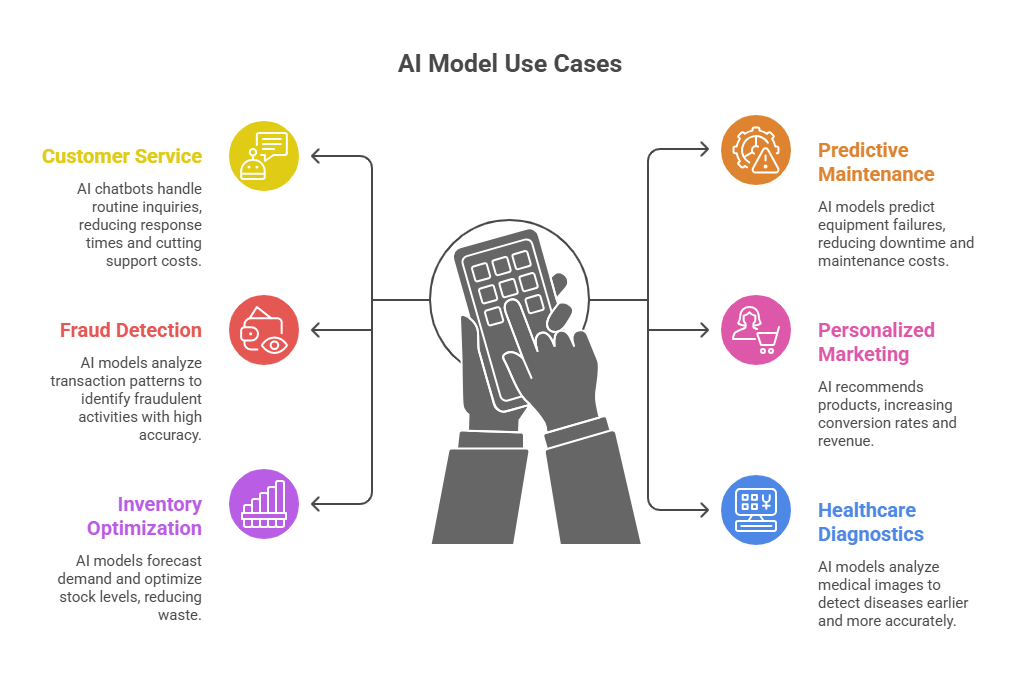
1. Customer Service: AI chatbots handle 70-80% of routine inquiries, reducing response times from hours to seconds while cutting support costs by 30-40%. Banks like Bank of America use AI assistants to serve millions of customers simultaneously.
2. Predictive Maintenance: Manufacturing companies deploy AI models to predict equipment failures before they occur, reducing downtime by 35-50% and maintenance costs by 25%. General Electric saves millions annually through AI-driven maintenance schedules.
3. Fraud Detection: Financial institutions use AI models to analyze transaction patterns in real-time, identifying fraudulent activities with 95%+ accuracy while minimizing false positives that frustrate legitimate customers.
4. Personalized Marketing: E-commerce platforms leverage AI to recommend products, increasing conversion rates by 20-30%. Amazon attributes 35% of its revenue to AI-powered recommendation engines.
5. Inventory Optimization: Retailers use AI models to forecast demand, optimize stock levels, and reduce waste. Walmart’s AI systems manage inventory across thousands of stores, improving availability while cutting carrying costs.
6. Healthcare Diagnostics: AI models analyze medical images to detect diseases earlier and more accurately than traditional methods, improving patient outcomes while reducing diagnostic costs.
Also Read : Key AI Models and Algorithms Every Business Should Know in 2026
Why Choose Amplework
Amplework is a leading AI development service provider, specializing in translating AI potential into tangible business results. Our team delivers end-to-end AI solutions, from strategy and AI model development to deployment and optimization, leveraging our expertise to build solutions that drive measurable outcomes. We focus on practical, ROI-driven implementations that solve real challenges, not just technical experiments. With proven frameworks across industries, Amplework ensures your AI initiatives deliver lasting value from day one. Our collaborative approach means you’re not just adopting technology, you’re partnering with a team committed to your success.
Conclusion
Understanding what is an AI model enables businesses to solve real challenges, enhance operations, and drive innovation by aligning the right technology with quality data, clear objectives, and expert partnerships, ensuring strategic, measurable impact and long-term competitive advantage.
 sales@amplework.com
 (+91) 9636-962-228