

Machine Learning Development Services: What Businesses Need
Introduction
Businesses recognize machine learning’s potential but struggle to translate vision into working systems. They lack internal expertise for data preparation, model development, deployment, and maintenance. Hiring full ML teams proves expensive and time-consuming while projects demand immediate expertise across multiple specializations.
Machine learning development services provide the specialized skills businesses need without permanent hiring commitments. Professional ML developers deliver end-to-end solutions from problem definition through production deployment and ongoing optimization. Understanding what these services include helps organizations select appropriate support for their AI initiatives.
Core Machine Learning Development Services
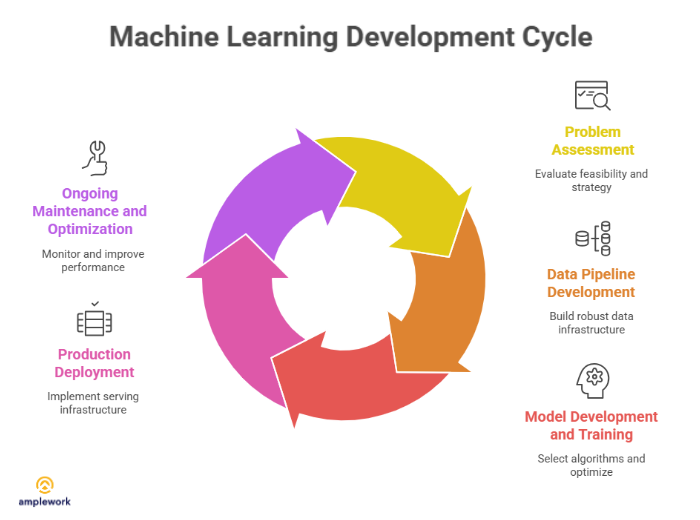
Problem Assessment and Strategy
ML development solutions begin with comprehensive problem analysis. Experienced developers evaluate whether ML is the right approach, identify suitable techniques, assess data readiness, and recommend implementation strategies. This strategic guidance prevents pursuing unworkable solutions.
Strategic services include:
- Use case feasibility evaluation
- Technical approach recommendation
- Data requirement assessment
- Timeline and budget estimation
- Risk identification and mitigation
Strategic assessment ensures ML investments target achievable, high-value opportunities.
Data Pipeline Development
ML systems require a robust data infrastructure. Developers build pipelines collecting, cleaning, transform, and preparing data for model training. These pipelines handle ongoing data flows, maintaining model performance over time.
Data pipeline services:
- Data collection automation
- Cleaning and preprocessing
- Feature engineering
- Data validation systems
- Version control implementation
Quality data pipelines determine ML system reliability and accuracy.
Model Development and Training
Core ML expertise involves selecting appropriate algorithms, AI model training on prepared data, and optimizing performance. Developers experiment with multiple approaches, tune hyperparameters, and validate results, ensuring models meet business requirements.
Model development includes:
- Algorithm selection and testing
- Model training and optimization
- Performance validation
- Bias detection and mitigation
- Documentation and versioning
Expert model development translates business problems into accurate, reliable predictions.
Production Deployment
Moving models from development to production requires specialized skills. Developers build serving infrastructure, create APIs, implement monitoring, and establish deployment pipelines. Production deployment transforms experimental models into business-critical systems.
Deployment services include:
- Model serving infrastructure
- API development and documentation
- Performance monitoring setup
- Security implementation
- Scaling and optimization
Professional deployment ensures ML systems operate reliably under real-world conditions.
Ongoing Maintenance and Optimization
ML systems require continuous monitoring and improvement. Developers track performance, detect data drift, retrain models with new data, and optimize based on production usage patterns. Maintenance ensures sustained value delivery.
Maintenance services include:
- Performance monitoring
- Model retraining automation
- Drift detection and correction
- System optimization
- Incident response
Ongoing support prevents performance degradation and maximizes long-term ROI.
Specialized ML Development Solutions
Computer Vision Development
Image and video analysis applications require specialized expertise. Developers build object detection, image classification, facial recognition, and visual inspection systems using deep learning and convolutional neural networks.
Natural Language Processing
Text analysis, chatbots, sentiment analysis, and document processing need NLP specialists. Developers work with transformers, language models, and text processing pipelines handling unstructured language data.
Time Series Forecasting
Prediction applications for sales, demand, equipment failure, or market trends require time series expertise. Developers build forecasting models handling temporal dependencies and seasonal patterns.
Recommendation Systems
Personalization engines suggesting products, content, or actions need collaborative filtering and recommendation algorithm specialists. Developers build systems learning individual preferences at scale.
Anomaly Detection
Fraud detection, quality control, and security monitoring require anomaly detection expertise. Developers build systems identifying unusual patterns in transactions, processes, or behaviors.
Also Read : When You Need an ML Infrastructure Expert for Your AI Project
What Businesses Actually Need
Flexible Engagement Models
Projects have different needs; some require full teams while others need specific specialists. AI development services should offer flexibility from individual consultants to complete dedicated teams matching project requirements.
Domain Knowledge Transfer
Beyond building systems, businesses need internal capability development. Quality ML developers provide training, documentation, and knowledge transfer ensuring organizations maintain systems independently.
Realistic Expectations Management
Professional developers set realistic timelines and performance expectations based on data quality and problem complexity. They honestly assess feasibility rather than overpromising capabilities.
End-to-End Responsibility
Businesses need partners handling complete lifecycles, not developers who disappear after model training. Comprehensive services cover strategy through production deployment and ongoing support.
Transparent Communication
Non-technical stakeholders need clear explanations of technical approaches, progress, and challenges. ML expertise includes translating complex concepts into business language that executives understand.
Evaluating ML Development Service Providers
Technical Depth: Verify genuine ML expertise through past projects, technical assessments, and demonstrated knowledge across algorithms, frameworks, and deployment practices.
Industry Experience: Domain-specific experience in your sector indicates understanding of common challenges, data characteristics, and realistic performance expectations.
Process Maturity: Established development methodologies, quality assurance practices, and project management approaches indicate reliable delivery capabilities.
Communication Skills: Ability to explain technical concepts clearly and maintain transparent project communication is as important as technical skills.
Portfolio Quality: Review previous projects, assessing complexity, similarity to your needs, and measurable outcomes delivered for other clients.
Also Read : Tools & Platforms Used for AI Model Training: What Professionals Choose in 2026
Common ML Development Challenges
Data Quality Issues: Poor data quality limits model performance. Professional developers identify and address data problems early.
Scope Creep: ML projects can expand indefinitely. Experienced developers maintain focus on core requirements while identifying extension opportunities.
Integration Complexity: Connecting ML systems with existing infrastructure presents challenges. Professional services include comprehensive integration planning and execution.
Performance Optimization: Initial models often require optimization for production speed and cost. Expert developers balance accuracy with operational efficiency.
Conclusion
Machine learning development services provide the specialized expertise businesses need for successful AI implementations. Professional ML developers deliver complete solutions from strategy through production deployment and ongoing maintenance.
At Amplework Software, you can hire ML developers to deliver end-to-end machine learning solutions, combining technical expertise and business insight, ensuring successful projects, strategic planning, and optimized implementation across industries.
 sales@amplework.com
 (+91) 9636-962-228