
How to Scale With AI: Roadmap for Enterprises
Introduction
Successfully scaling AI across an enterprise is a critical challenge that separates organizations achieving real impact from those stuck in pilot mode. While initial AI projects may demonstrate potential, only a fraction reach full production due to technical, operational, and organizational hurdles. Scaling effectively requires more than technology; it demands robust infrastructure, reliable data, cross-functional collaboration, and strong change management.
This roadmap provides a practical, step-by-step approach for enterprises to expand AI initiatives from isolated successes to enterprise-wide transformation, ensuring measurable business outcomes, sustainable efficiency gains, and long-term competitive advantage.
Understanding the AI Scaling Challenge
Enterprise AI scaling differs fundamentally from scaling traditional software. AI systems depend on data quality, require continuous monitoring and retraining, face integration complexities, and demand organizational change management. What works with 1,000 data points may fail with millions. What succeeds in one department may encounter resistance elsewhere.
Common scaling obstacles include:
- Data infrastructure is inadequate for production volumes
- Model performance degradation with real-world data
- Integration challenges with legacy systems
- Organizational resistance to AI-driven processes
- Lack of clear governance and standards
- Insufficient technical talent and expertise
- Unclear ROI measurement frameworks
A comprehensive AI scaling strategy addresses these challenges systematically rather than treating them as isolated problems.
Enterprise AI Scaling Roadmap
Successfully enterprise AI Scaling requires more than technology; it demands strategy, infrastructure, and adoption. This roadmap guides enterprises in implementing enterprise AI solutions that deliver measurable impact and sustainable results.
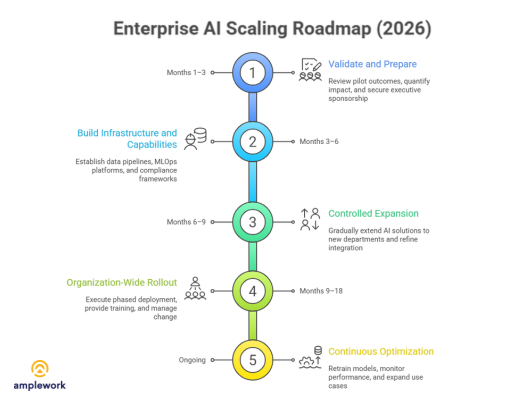
1: Validate and Prepare (Months 1–3)
- Review pilot outcomes critically.
- Quantify business impact with conservative projections.
- Assess organizational readiness and secure executive sponsorship.
2: Build Infrastructure and Capabilities (Months 3–6)
- Establish scalable data pipelines, MLOps platforms, and monitoring systems.
- Implement robust security, governance, and compliance frameworks.
- Build organizational capabilities via training, hiring, and role definition.
3: Controlled Expansion (Months 6–9)
- Extend AI solutions to additional departments or functions gradually.
- Monitor performance, gather feedback, and refine integration processes.
- Document lessons learned to create a repeatable playbook.
4: Organization-Wide Rollout (Months 9–18)
- Execute phased deployment across the enterprise with clear milestones.
- Provide comprehensive training and dedicated support teams.
- Implement change management initiatives to address resistance.
5: Continuous Optimization (Ongoing)
- Retrain models with fresh data regularly.
- Monitor performance and address data drift or technical debt.
- Expand AI applications to new use cases and business functions.
Scaling AI Across Different Enterprise Functions
- Customer Service: Start with chatbots handling routine inquiries, then expand to sentiment analysis, personalized recommendations, and predictive issue resolution.
- Operations: Begin with process automation in specific areas, scale to supply chain optimization, predictive maintenance, and resource allocation across the organization.
- Sales and Marketing: Initial customer segmentation and lead scoring pilots expand to personalized content generation, campaign optimization, and revenue forecasting.
- Finance: Fraud detection or expense processing automation scales to comprehensive risk analysis, financial forecasting, and regulatory compliance automation.
- Human Resources: Start with AI-assisted resume screening and candidate matching, then scale to employee performance analytics, attrition prediction, and workforce planning.
- IT & Security: Begin with automated monitoring and anomaly detection, then scale to threat prediction, incident response automation, and enterprise-wide cybersecurity optimization.
Common Scaling Mistakes to Avoid
- Premature Scaling: Rushing to deploy before adequately validating technology, processes, and readiness causes expensive failures.
- Underestimating Change Management: Treating AI scaling as purely technical ignores human factors that determine success or failure.
- Inadequate Infrastructure Investment: Trying to scale on pilot-grade infrastructure leads to performance issues and user frustration.
- Lack of Governance: Without clear policies, standards, and oversight, scaled AI initiatives create compliance risks and inconsistent quality.
- Insufficient Monitoring: Failing to track model performance in production allows degradation to go unnoticed until serious problems emerge.
Also Read : Different Types of AI Models and Their Drawbacks
Why Choose Amplework for AI Scaling
Enterprise AI Scaling requires both technical excellence and enterprise experience. We offer expert AI consulting services to support enterprises in:
- Infrastructure design and MLOps implementation for production-grade AI
- Phased rollout strategies minimizing risk and accelerating value
- Change management programs ensure adoption and business alignment
- Ongoing optimization and support to maximize ROI
We at Amplework have successfully guided enterprises across multiple industries, delivering measurable results and sustainable capabilities. Partnering with our team ensures your AI initiatives move from isolated wins to organization-wide impact.
Conclusion
Enterprise AI Scaling is a strategic initiative that requires aligning technology, processes, and people while addressing data quality, governance, and adoption. Following a structured roadmap, validating readiness, building scalable infrastructure, expanding gradually, rolling out organization-wide, and continuously optimizing, ensures measurable value and sustainable competitive advantage.
 sales@amplework.com
 (+91) 9636-962-228