

How Retailers Use NLP + LLMs for Product Discovery, Search & Personalization
Introduction
Modern retail success depends on helping customers find exactly what they want, exactly when they want it. Traditional keyword-based search frustrates 68% of online shoppers who abandon sites when products are hard to discover. Enter NLP in retail and retail LLM technologies, transforming how customers search, discover, and receive personalized recommendations through natural language understanding and intelligent automation.
This blog explores how NLP and LLMs in retail enhance product discovery, improve search accuracy, deliver personalized recommendations, and drive operational efficiency.
What Are NLP and LLMs?
Natural Language Processing (NLP) is a branch of artificial intelligence that enables computers to understand, interpret, and generate human language. In retail, NLP allows systems to make sense of customer queries, product descriptions, and other unstructured text data.
Large Language Models (LLMs) are advanced machine learning models trained on massive text corpora. They extend the capabilities of traditional NLP by understanding context, intent, and semantics in human language. LLMs like GPT-class models can generate coherent language, answer questions, summarize text, and adapt to various retail use cases.
Together, NLP and LLMs in retail power smarter, more intuitive customer interactions and efficient backend processes.
Enhancing Product Discovery
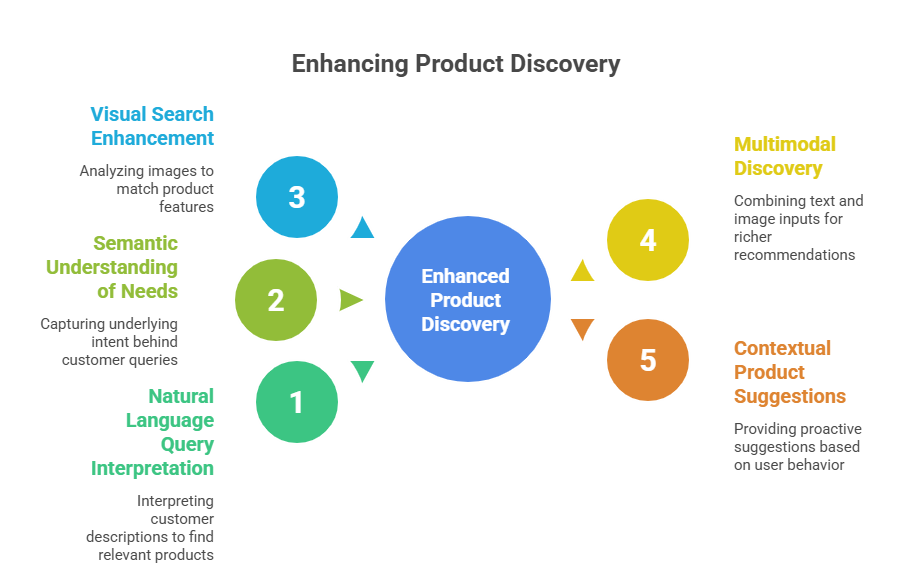
Product discovery ensures customers find relevant items quickly, increasing engagement and conversion rates.
1. Natural Language Query Interpretation
Customers often describe needs in their own words rather than exact product names. NLP solutions interpret these inputs, and LLMs map intent to attributes, categories, and use cases, delivering relevant product results efficiently.
2. Semantic Understanding of Needs
LLMs analyze query meaning to capture underlying intent. This ensures that functional requirements, style preferences, or occasion-specific needs are matched with appropriate products across large catalogs.
3. Visual Search Enhancement
Uploaded images are analyzed using computer vision to detect color, texture, shape, and patterns. LLMs then connect these features to product metadata, producing accurate and contextually relevant recommendations.
4. Multimodal Discovery
Platforms combining text and image inputs provide richer recommendations. Both visual and textual signals are interpreted simultaneously, ensuring products match customer intent across multiple dimensions.
5. Contextual Product Suggestions
LLMs consider browsing history, session behavior, and previous interactions to deliver proactive suggestions. This reduces search effort and creates a seamless, intuitive, and highly relevant discovery experience.
Revolutionizing Search Accuracy
Accurate search interprets intent and context, reducing frustration and improving conversion for retailers.
1. Semantic Search
Semantic search understands the meaning behind queries, not just literal keywords. NLP + LLMs map intent to product attributes and categories, ensuring results align with the customer’s actual goals.
2. Attribute and Facet Extraction
Key product characteristics such as size, color, material, or brand are automatically extracted from queries and catalogs. This enables effective faceted navigation, helping customers refine results efficiently.
3. Query Expansion
Brief or incomplete queries are expanded with related terms and attribute variations. NLP ensures the system interprets intended meaning accurately, providing broader yet relevant search results for improved discoverability.
4. Handling Ambiguity
Ambiguous queries are resolved using session context, browsing patterns, and past behavior. LLMs prioritize the most relevant products dynamically, reducing irrelevant results and improving overall search satisfaction.
5. Visual Search in Results
Visual search integrated with textual queries enhances relevance. Customers can find products similar in appearance while retaining contextual alignment, ensuring a seamless search experience across complex catalogs.
Also Read : The Future of Large Language Models: How to Choose the Right LLM for Your Business Needs
Personalization at Scale
Personalization delivers tailored experiences based on behavior, context, and preferences to drive loyalty.
1. Contextual Recommendations
LLMs analyze past interactions, session patterns, and preferences to suggest products aligned with style, seasonal relevance, or price sensitivity, creating an engaging and highly relevant shopping experience.
2. Dynamic Content Generation
AI models generate personalized product descriptions, promotional messages, and marketing content. This improves engagement and conversion while providing tailored experiences for each individual customer.
3. Conversational Assistants
Natural language interfaces allow customers to ask questions or request suggestions. LLMs combine contextual and visual signals to interpret intent and provide precise product recommendations efficiently.
4. Behavioral Personalization
Real-time monitoring of browsing patterns, clicks, and interactions adjusts recommendations dynamically. This ensures the products displayed are always relevant and personalized for the ongoing session.
5. Cross-Platform Personalization
Personalization extends across websites, mobile apps, and email campaigns. LLMs ensure consistent, tailored experiences regardless of the platform, driving loyalty and enhancing engagement across channels.
Operational Advantages of NLP and LLMs in Retail
Beyond enhancing customer experiences, NLP vs LLM in ecommerce drives efficiency and insight across internal retail operations:
- Automated Catalog Tagging: NLP categorizes products and enriches metadata, ensuring accurate filtering, search relevance, and recommendation performance.
- Sentiment Analysis: Extracts actionable insights from customer reviews, support tickets, and social feedback to guide product strategy and quality improvements.
- Trend Forecasting: Analyzes search logs, social chatter, and emerging patterns to anticipate demand and inform inventory and merchandising decisions.
- Operational Workflow Automation: Automates repetitive tasks such as data entry, report generation, and content standardization, increasing team productivity and reducing errors.
These capabilities streamline operations, improve decision-making, and create a measurable impact on retail efficiency and profitability.
Also Read : How NLP Software Helps Businesses Automate Customer Support, Documents & Search
Conclusion
NLP and LLMs in retail are transforming product discovery, search, and personalization, making experiences more intelligent and customer-centric. Retailers that leverage these technologies gain a competitive edge through higher engagement, improved conversion rates, and deeper customer loyalty.
For retailers looking to implement these advanced AI capabilities, Amplework provides expert AI development services, helping businesses integrate NLP + LLM solutions seamlessly. By partnering with Amplework, retailers can deploy scalable, customized solutions that enhance product discovery, optimize search accuracy, and deliver personalized experiences.
 sales@amplework.com
 (+91) 9636-962-228