

Generative NLP Services: How GPT Models Enhance Traditional NLP
Introduction
The emergence of generative NLP services has fundamentally transformed how businesses approach natural language processing. While traditional NLP served enterprises well for years, GPT models for NLP have introduced capabilities that were previously impossible or impractical to achieve. Understanding the distinctions and synergies between these approaches is essential for organizations looking to maximize their investment in enterprise NLP solutions.
Understanding the Evolution: GPT vs Traditional NLP
Traditional NLP relied heavily on rule-based systems, statistical models, and task-specific training. These approaches required extensive feature engineering, large labeled datasets, and separate models for different tasks like classification, entity recognition, and sentiment analysis. While effective for specific use cases, traditional methods had limitations in handling context, generating human-like text, and adapting to new domains.
Generative AI in NLP, powered by large language models (LLMs) like GPT, represents a paradigm shift. These transformer-based NLP models learn patterns from vast amounts of text data, enabling them to:
- Understand context across long passages of text
- Generate coherent, contextually appropriate responses
- Perform multiple NLP tasks with a single model
- Adapt to new tasks with minimal additional training
- Handle ambiguity and nuanced language more effectively
The key difference in GPT vs traditional NLP lies in versatility and scalability. While traditional models excel at specific, well-defined tasks, NLP services using GPT offer broader capabilities with less domain-specific customization.
Core Capabilities of Generative NLP Services
Modern generative NLP services leverage the power of transformer-based architectures to deliver comprehensive solutions:
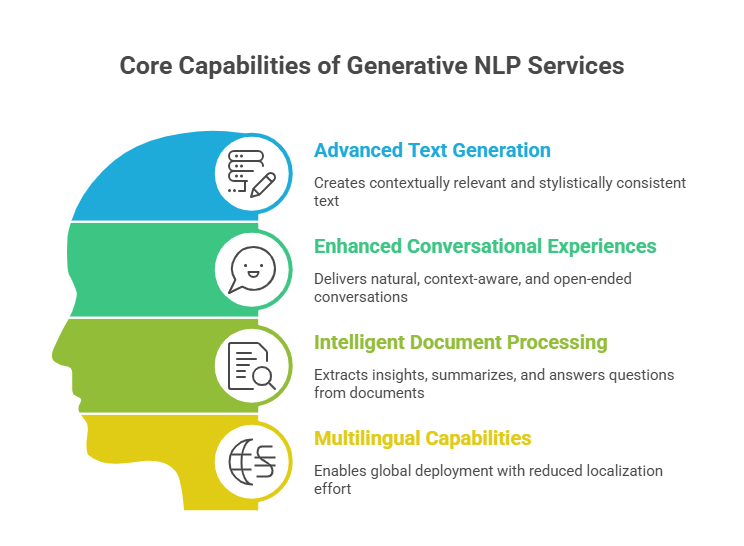
- Advanced Text Generation: Text generation AI can create marketing copy, product descriptions, reports, and customer communications that are contextually relevant and stylistically consistent. Businesses use these capabilities for content automation, personalization at scale, and creative assistance.
- Enhanced Conversational Experiences: Conversational AI services built on GPT models deliver more natural, context-aware interactions. Unlike traditional chatbots limited to predefined responses, generative models can handle open-ended conversations, understand intent across multiple turns, and provide nuanced answers.
- Intelligent Document Processing: GPT models for NLP excel at extracting insights from unstructured documents, summarizing lengthy reports, and answering specific questions about complex content without manual rule creation.
- Multilingual Capabilities: Large language models demonstrate strong cross-lingual understanding, enabling businesses to deploy solutions across global markets with reduced localization effort.
GPT Use Cases in Business
Organizations across industries are discovering innovative GPT use cases in business that drive efficiency and competitive advantage:
- Customer Support Automation: NLP automation for enterprises includes AI-powered support systems that understand customer queries, provide detailed responses, and escalate complex issues appropriately. These systems reduce response times while maintaining quality.
- Content Operations: Marketing and communications teams use generative NLP services for drafting, editing, and optimizing content. From email campaigns to social media posts, AI-powered text analysis ensures messaging consistency and effectiveness.
- Knowledge Management: Enterprise NLP solutions help organizations extract value from internal documentation, meeting transcripts, and institutional knowledge. Employees can query information conversationally rather than searching through multiple systems.
- Data Analysis and Reporting: GPT models can analyze datasets, identify trends, and generate executive summaries, transforming raw data into actionable insights with natural language explanations.
Also Read : How to Find the Right NLP Consulting Firm or AI Agency
Implementation Considerations
When adopting NLP services using GPT, enterprises should consider:
- Data Privacy and Security: Generative NLP models require careful handling of sensitive data. On-premises deployment or fine-tuned models can ensure secure, compliant, and enterprise-ready AI solutions.
- Cost-Benefit Analysis: While generative AI reduces development time, computational and inference costs can be significant. Evaluate total cost versus expected efficiency and business value gains.
- Quality Control: Establish robust review processes for AI-generated content. Human oversight is critical for accuracy, consistency, and appropriateness, particularly in customer-facing or high-stakes applications.
- Integration Strategy: Seamlessly integrate AI with existing systems, workflows, and data sources using professional AI integration services to ensure efficient, compatible, and scalable enterprise deployment.
- Performance Monitoring: Continuously track AI outputs, user feedback, and model performance. Detect drift early, ensure reliability, and make timely updates to maintain contextual accuracy and relevance.
The Future of Enterprise NLP Solutions
As transformer-based NLP models continue to evolve, the line between traditional and generative approaches will blur further. Organizations investing in generative NLP services today position themselves to leverage increasingly sophisticated capabilities while maintaining the reliability and precision that traditional methods provide.
The optimal strategy combines the contextual understanding and flexibility of GPT models with the precision and explainability of traditional NLP, creating conversational AI services that truly transform business operations.
Also Read : Customer Support NLP: Automating Chats, Tickets & Voice Support
Why Choose Amplework
Amplework combines technical expertise with a business-focused approach to help enterprises implement AI solutions effectively. By leveraging generative NLP services and GPT-powered models, organizations can achieve contextually accurate, scalable, and secure AI deployments that align with operational goals.
Key Benefits:
- Expertise in generative NLP services and GPT-powered solutions
- Seamless integration with existing enterprise systems
- Scalable and contextually accurate AI deployments
- Focus on data privacy and security
- Actionable insights from text, conversation, and document processing
- Business-focused AI strategies ensuring measurable results
Conclusion
Generative NLP services, combined with traditional NLP, deliver precise, scalable, and context-aware AI solutions. Partnering with Amplework ensures reliable implementation, improved efficiency, and actionable insights, helping enterprises maximize value from AI while minimizing operational risks.
 sales@amplework.com
 (+91) 9636-962-228