
Generative AI PoC Services in 2026: What You Can Build, Use Cases & Cost Breakdown
Introduction
As we navigate through 2026, generative AI PoC services have become essential for businesses wanting to validate AI investments before committing significant resources. The landscape has matured dramatically; what once took months and hundreds of thousands of dollars can now be prototyped in weeks with substantially lower costs. Understanding what’s possible, realistic use cases, and GenAI PoC pricing helps organizations make informed decisions about their AI transformation journey.
This guide explores what businesses can actually build with generative AI Proof of Concepts in 2026, showcases real genai poc examples across industries, and provides transparent cost breakdowns to help you budget effectively.
What Is a Generative AI PoC?
A Generative AI Proof of Concept (PoC) is a limited-scope implementation designed to validate whether a generative AI solution can solve a specific business problem before full-scale development. Unlike production systems, PoCs focus on demonstrating technical feasibility, business value potential, and user acceptance with minimal investment.
In 2026, GenAI PoCs typically leverage advanced models like GPT-5, Claude 4, Gemini Pro, and open-source alternatives like Llama 4, combined with techniques like Retrieval-Augmented Generation (RAG), fine-tuning, and multi-modal capabilities. The goal is rapid validation, usually 4-8 weeks, to inform go/no-go decisions for larger investments.
What You Can Build with GenAI PoC Services in 2026
The capabilities of generative AI PoC services in 2026 span far beyond simple chatbots:
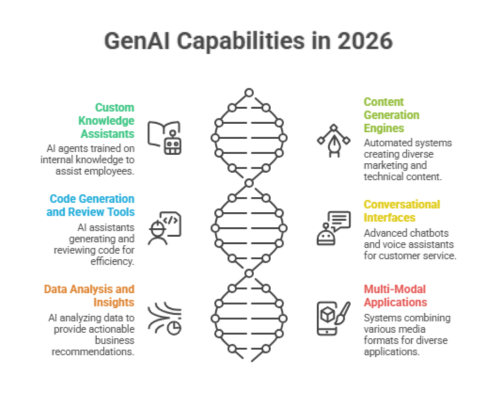
1. Custom Knowledge Assistants
AI agents trained on your company’s internal knowledge base, policies, and procedures that answer employee questions, guide decision-making, and automate routine inquiries. PoCs typically focus on one department or use case.
2. Content Generation Engines
Automated systems create marketing copy, product descriptions, technical documentation, social media content, or personalized email campaigns. PoCs validate brand voice alignment and output quality.
3. Code Generation and Review Tools
AI assistants that generate code snippets, review pull requests, identify security vulnerabilities, and suggest optimizations. PoCs focus on specific programming languages or frameworks relevant to your stack.
4. Conversational Interfaces
Advanced chatbots and voice assistants handling customer service, sales qualification, technical support, or internal help desk functions. PoCs test handling of your actual customer scenarios.
5. Data Analysis and Insights
AI that analyzes business data, generates reports, identifies trends, and provides actionable recommendations in natural language. PoCs demonstrate value with your actual datasets.
6. Multi-Modal Applications
Systems combining text, images, audio, and video, like generating product descriptions from photos, creating visual content from text descriptions, or analyzing video content for insights.
Real GenAI PoC Examples Across Industries
- Healthcare: A clinical documentation assistant transcribed doctor-patient conversations, generated structured notes, and suggested diagnosis codes, reducing documentation time by 40 percent during a four-week pilot.
- E-commerce: A product description generator created high-quality content from specifications and images for 500 SKUs, achieving a 95 percent approval rate and producing descriptions 50 times faster.
- Financial Services: A contract analysis tool extracted key terms and risks across 200 contracts, reducing review time from two hours to fifteen minutes per document with 92 percent accuracy.
- Manufacturing: A maintenance knowledge assistant answered technician queries using manuals and service history, resolving 70 percent of issues without escalation and helping reduce equipment downtime.
- Legal: A legal research assistant analyzed case law, identified relevant precedents, and drafted initial briefs, reducing legal research time by 60 percent while improving overall coverage.
Also Read : Proof of Concept in AI Technologies: What It Is, Why It Matters & When to Use It
GenAI PoC Pricing: Complete Cost Breakdown
GenAI poc pricing in 2026 varies based on complexity, scope, and required deliverables, but typical ranges include:
1. Basic PoC – Starting at $5,000
- Timeline: 2-3 weeks
- Scope: Single use case using existing data and standard GenAI models
- Deliverables: Functional prototype, basic performance metrics, and a recommendation summary
- Best For: Simple applications such as chatbots, FAQ automation, or basic document summarization
2. Standard PoC – Starting at $15,000
- Timeline: 4-5 weeks
- Scope: Moderate complexity, including data preparation and custom fine-tuning
- Deliverables: Working prototype, integration with 1-2 systems, detailed evaluation report, and scaling recommendations
- Best For: Knowledge assistants, content generation, or document processing with moderate customization
3. Advanced PoC – Starting at $30,000
- Timeline: 6-8 weeks
- Scope: Complex multi-modal applications, extensive fine-tuning, and multiple integrations
- Deliverables: Production-ready prototype, comprehensive documentation, security assessment, and deployment plan
- Best For: Mission-critical applications, highly specialized domains, or complex workflow integration
Cost Components Breakdown:
- Discovery & Planning (15%): Requirements gathering, data assessment, architecture design
- Data Preparation (25%): Cleaning, labeling, and structuring data for training/RAG
- Model Development (30%): Fine-tuning, prompt engineering, RAG implementation
- Integration & Testing (20%): API development, system integration, validation
- Documentation & Handoff (10%): Technical docs, user guides, presentation of findings
- Ongoing Costs: Production deployment introduces ongoing costs related to API usage, infrastructure, and monitoring, which increase based on application scale and real-world usage.
Key Success Factors for GenAI PoCs
- Clear Success Metrics: Define quantifiable goals, accuracy targets, time savings, and cost reductions before starting. Without clear benchmarks, PoC results remain subjective.
- Quality Data Access: Successful PoCs require representative data. Allocate time for data collection and preparation, often 30-40% of PoC effort.
- Realistic Scope: Focus on proving one core capability thoroughly rather than multiple features superficially. Narrow scope increases PoC success rates.
- Stakeholder Involvement: Include end users in testing and feedback. Technical success means nothing if users won’t adopt the solution.
- Clear Next Steps: Define criteria for moving from PoC to production before starting, including budget allocation and timeline for full implementation.
Also Read : Prototype vs AI Proof of Concept: Differences, Use Cases & How to Choose the Right Approach
Conclusion
Generative AI PoC services in 2026 offer businesses low-risk pathways to validate AI investments before large-scale commitments. By testing real-world feasibility early, organizations can assess technical alignment, operational impact, and scalability with minimal risk.
Amplework supports organizations throughout the GenAI PoC journey by aligning technical experimentation with business outcomes. From use case definition and data readiness to AI model development, evaluation, and deployment planning, Amplework helps teams validate feasibility, reduce uncertainty, and confidently transition from proof of concept to production.
 sales@amplework.com
 (+91) 9636-962-228