

Generative AI Integration Services: Connecting GenAI Models to Real Systems
Introduction
Powerful generative AI models like GPT-4, Claude, and other LLMs exist, yet most organizations struggle connecting them to actual business systems. Companies experiment with ChatGPT but can’t figure out how to integrate these capabilities into their products, workflows, and databases. This integration gap prevents businesses from realizing generative AI’s transformative potential despite investing in the technology.
Generative AI integration services bridge this gap by connecting GenAI models to real enterprise systems, data sources, and applications. Professional integration transforms standalone AI capabilities into embedded features that enhance existing products and workflows. Understanding how GenAI integration works helps organizations move from experimentation to production deployment that delivers measurable business value.
Key Generative AI Integration Services
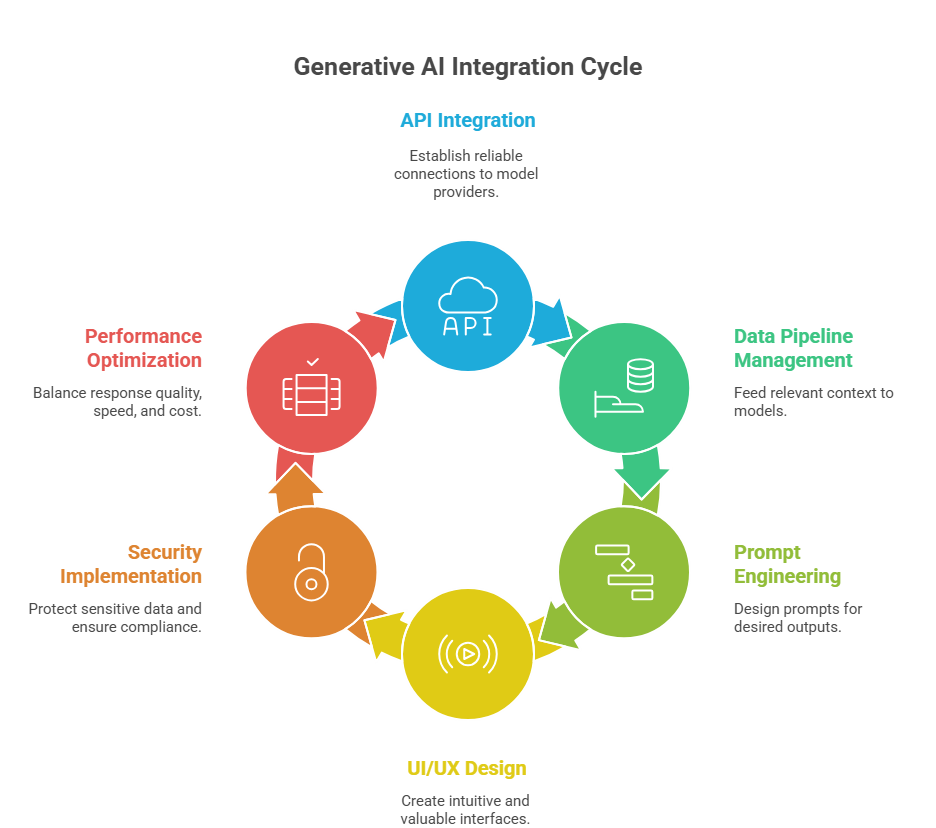
1. API Integration and Model Connectivity
Connecting generative AI models to applications requires robust API integration, handling authentication, rate limiting, error handling, and failover. LLM integration services establish reliable connections to model providers while managing costs through efficient API usage and caching strategies.
API integration includes:
- Secure authentication implementation
- Rate limit management
- Error handling and retry logic
- Response caching optimization
- Multi-model fallback strategies
Proper API integration ensures reliable GenAI functionality even during peak usage or provider issues.
2. Data Pipeline and Context Management
Integrating generative AI into products requires feeding relevant context to models. This involves building pipelines that retrieve, process, and format data from databases, documents, and systems. Context management ensures models receive appropriate information for accurate, relevant responses.
Data pipeline components:
- Real-time data retrieval systems
- Document processing and chunking
- Vector database integration
- Context window optimization
- Relevance filtering mechanisms
Effective context management dramatically improves GenAI output quality and relevance for specific business applications.
3. Prompt Engineering and Orchestration
Custom generative AI development includes designing prompts that consistently produce desired outputs. Prompt orchestration manages complex workflows involving multiple model calls, decision logic, and output processing. This orchestration layer ensures reliable, predictable GenAI behavior.
Orchestration features include:
- Template-based prompt management
- Multi-step workflow coordination
- Output validation and formatting
- Conditional logic implementation
- A/B testing capabilities
Sophisticated orchestration transforms unpredictable GenAI responses into reliable business functionality.
4. User Interface and Experience Design
GenAI-powered apps require thoughtful UX design, managing user expectations, loading states, streaming responses, and error conditions. Integration services design interfaces that make GenAI capabilities intuitive and valuable rather than confusing or frustrating.
UI integration includes:
- Streaming response implementation
- Loading state management
- Error message handling
- Feedback collection mechanisms
- Progressive disclosure patterns
Good UX design makes the difference between GenAI features users love and ones they avoid.
5. Security and Compliance Implementation
Enterprise generative AI adoption requires strict security controls protecting sensitive data while satisfying compliance requirements. Integration services implement authentication, authorization, data filtering, audit logging, and content safety measures ensuring responsible GenAI usage.
Security measures include:
- Role-based access controls
- Data sanitization filters
- Content moderation systems
- Audit trail logging
- Compliance policy enforcement
Security implementation prevents data leaks and ensures GenAI systems meet regulatory requirements.
6. Performance Optimization and Cost Management
Production GenAI integration requires optimization balancing response quality, speed, and cost. Integration services implement caching, model selection logic, and usage optimization reducing operational expenses while maintaining acceptable performance.
Optimization strategies include:
- Response caching mechanisms
- Model tier selection logic
- Batch processing where appropriate
- Token usage optimization
- Performance monitoring systems
Cost optimization prevents surprisingly expensive GenAI bills while maintaining necessary capabilities.
Challenges in Integrating Generative AI into Products
- Latency and User Experience: GenAI responses can be slow. Use streaming, progress indicators, and clear expectations to maintain a smooth user experience.
- Output Consistency and Reliability: Model outputs vary. Apply validation, formatting rules, and fallback logic to ensure stable and predictable results.
- Context Window Limitations: Limited context capacity requires smart design. Use chunking, summarization, and relevance filtering to provide essential information.
- Cost Management: GenAI APIs can be costly. Reduce token usage, cache frequent responses, and select model tiers that balance capability with budget.
The Amplework Generative AI Integration Advantage
At Amplework Software, we specialize in connecting generative AI models to real business systems through comprehensive integration services. Our team has delivered 50+ GenAI integrations across industries, from customer-facing applications to internal workflow automation.
Our Generative AI Integration Services Include:
- Complete architecture design and planning
- Secure API integration implementation
- Custom data pipeline development
- User interface design and implementation
- Security and compliance configuration
Our generative AI development expertise extends beyond integration to custom model fine-tuning and training when solutions fall short, allowing you to hire AI developers as needed.
Also Read : How to Train an AI Model for Local Business Sales: A Real-World Framework
Conclusion
Generative AI integration services turn experimental models into reliable, production-ready features within real business systems. Effective integration manages architecture, security, performance, and user experience challenges that internal teams often overlook. Success depends more on integration quality than model choice. Organizations that invest in proper integration achieve scalable results, while basic API connections frequently fall short.
 sales@amplework.com
 (+91) 9636-962-228