
The Enterprise AI Maturity Curve: Where Most Organizations Are Stuck
Introduction
Most organizations believe they’re advancing steadily along their AI journey. They’ve completed pilots, secured executive buy-in, and allocated budgets. Yet three years later, they remain stuck at the same maturity level, running disconnected experiments that never scale to enterprise impact.
The enterprise AI maturity curve isn’t a smooth progression. It’s a series of distinct stages with specific transition challenges that trap most organizations. Understanding this curve and recognizing where you’re stuck is the first step toward breaking through to meaningful AI transformation.
What Is AI Maturity?
What does AI maturity really mean for large enterprises? It goes beyond pilots or new models. AI maturity reflects how systematically AI is embedded into core workflows, decision-making, and culture to deliver value that is measurable, repeatable, and scalable. As organizations mature, AI moves out of isolated use cases and begins to shape how work gets done across the business.
As this shift takes place, AI evolves from a supporting tool into a structural capability. Making that transition requires more than technical execution; it depends on aligned leadership, shared platforms, governed data foundations, and a culture ready to operate alongside intelligent systems. True maturity is reached when AI becomes integral to how the enterprise competes, adapts, and grows.
The Five Stages of AI Maturity
Enterprise AI maturity progresses through five distinct stages, each building on capabilities from the previous level:
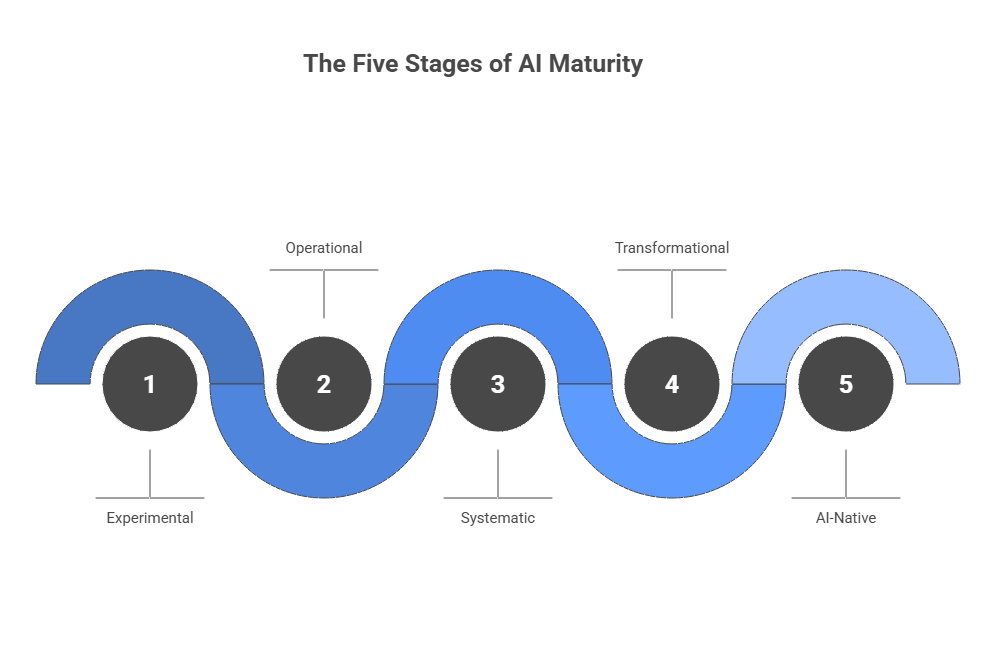
Stage 1: Experimental
Organizations run isolated AI pilots to test feasibility. Teams experiment with AI tools and platforms without a coordinated strategy. Success is measured by technical proof rather than business impact.
Stage 2: Operational
AI projects move from experimentation to production deployment. Individual business units implement enterprise AI solutions addressing specific problems. Some projects deliver value, but efforts remain siloed across the organization.
Stage 3: Systematic
Organizations develop standardized AI infrastructure, governance frameworks, and best practices. AI becomes repeatable rather than experimental. Common platforms, data infrastructure, and development processes enable consistent implementation.
Stage 4: Transformational
AI reshapes business models and operational processes. Organizations deploy AI at scale across functions, creating competitive advantages through unique AI capabilities. AI influences strategic decisions and drives innovation.
Stage 5: AI-Native
AI becomes foundational to how the organization operates. Autonomous systems handle routine decisions while humans focus on strategy and exceptions. The organization continuously evolves AI capabilities as a core competency.
Most organizations stall at Stage 2 or 3. Progress beyond this point requires solving organizational challenges, not just technical ones.
Where Organizations Get Stuck: The Three Critical Gaps
The Pilot-to-Production Gap (Stage 1 → Stage 2)
AI pilots prove technical feasibility but fail in real operations. Solutions that work in controlled environments break at scale, with live data, enterprise systems, and compliance constraints.
The Scaling Gap (Stage 2 → Stage 3)
Individual AI deployments succeed, but enterprise replication fails. Each project is rebuilt from scratch, preventing repeatability, speed, and consistent governance.
The Impact Gap (Stage 3 → Stage 4)
Organizations build systematic AI capabilities but see limited business impact. AI optimizes existing processes instead of transforming how value is created or sustained.
Roadmap to Accelerate AI Maturity
Organizations that successfully advance through AI maturity follow a structured approach. Here’s how you can do it:
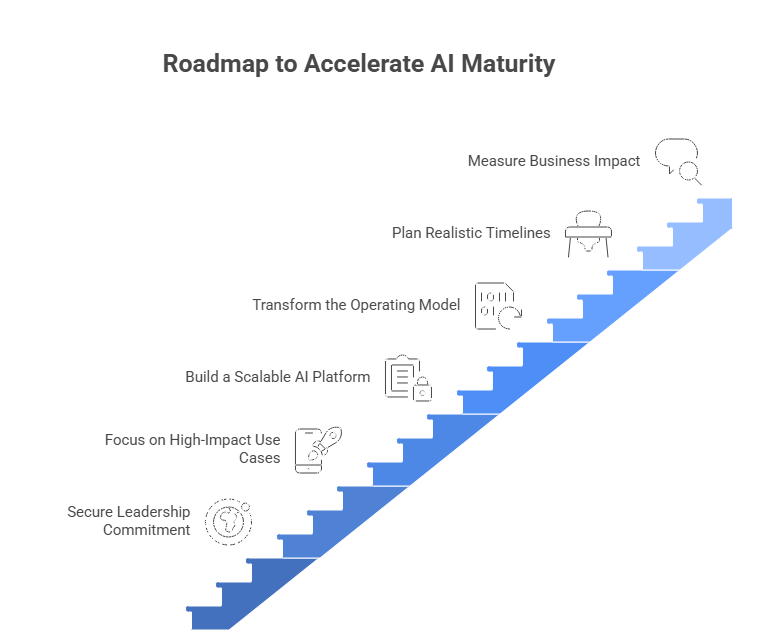
1. Secure Leadership Commitment: Ensure executives actively sponsor AI initiatives beyond initial pilots. Assign clear accountability for multi-year capability building and integrate AI into strategic business goals.
2. Focus on High-Impact Use Cases: Identify business problems where AI delivers the most value. Avoid scattered experimentation by defining clear criteria for which initiatives to pursue and which to defer.
3. Build a Scalable AI Platform: Invest in shared data platforms, ML pipelines, and governance frameworks that support multiple projects. Scalable AI integration ensures new initiatives reuse existing infrastructure and processes.
4. Transform the Operating Model: Redesign processes, evolve roles, and adapt organizational culture to embed AI into daily operations. AI should change how work gets done, not just automate existing tasks.
5. Plan Realistic Timelines: AI maturity takes time. Structure a multi-year roadmap that balances quick wins with long-term capability building. Avoid shortcuts that compromise scalability.
6. Measure Business Impact, Not Just Models: Track metrics that reflect real outcomes, revenue growth, cost reduction, or customer satisfaction, rather than only technical performance. Use this data to guide further AI investments.
Following this roadmap ensures AI moves from experimentation to operational excellence and ultimately to transformative business impact.
Also Read : AI Contextual Accuracy: Improving Precision in Enterprise AI
Conclusion
Many stall on the enterprise AI maturity curve because advancing requires more than technical skill; it demands addressing stage-specific obstacles. Closing the pilot-to-production gap, scaling AI across teams, and driving transformational impact each requires a different approach.
This journey can be accelerated with Amplework’s AI development services, providing scalable platforms, AI integration, and solutions that deliver measurable business outcomes.
Where is your organization on the maturity curve, and what’s stopping you from moving forward?
 sales@amplework.com
 (+91) 9636-962-228