

Why Embedded AI Models Are Becoming Enterprise Infrastructure
Introduction
87% of large enterprises now use AI, up sharply from just a few years ago. For years, these tools ran as separate systems, specialized platforms with their own interfaces, managed by data teams, and disconnected from core business apps. That setup made sense when AI was experimental, and companies lacked the know-how to integrate it deeply.
But those days are gone. Embedded AI models have become essential infrastructure, seamlessly built into the daily systems enterprises rely on. CRM platforms now include predictive models that anticipate customer needs right in the workflow. ERP systems embed AI to streamline supply chains in real time. Communication tools incorporate language models to enhance every interaction. This shift from standalone AI application to native intelligence is transforming enterprise architecture from the ground up.
What Embedded AI Actually Means
Embedded AI means integrating machine learning models directly into business applications and systems, rather than running them as separate platforms. Users no longer switch to an AI tool for recommendations; they appear right within the application they’re already using.
The difference appears subtle, yet it’s game-changing. A standalone fraud detection system pulls transaction data out, analyzes it elsewhere, and sends results back. An embedded model, however, lives inside the payment processing system itself, checking transactions in real time without data ever leaving the core flow.
This creates seamless experiences where AI appears like a native feature of the application, eliminating context switches and workflow disruptions.
Why Embedding Is Winning
Several forces are driving the shift toward embedded AI models:
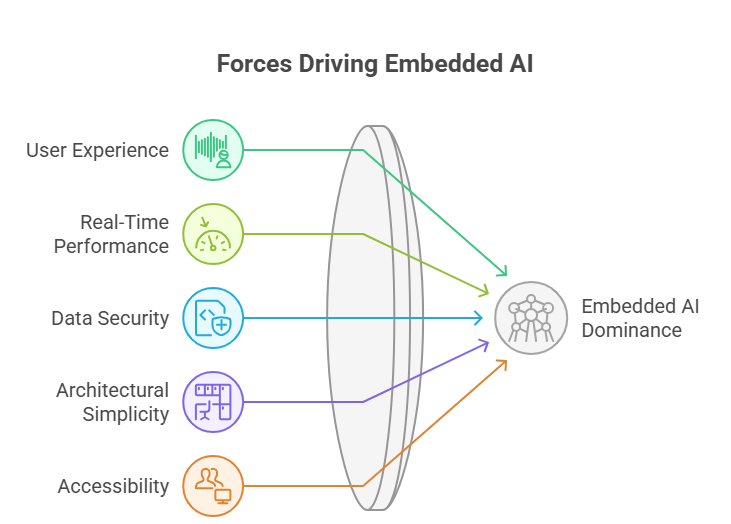
1. User Experience Demands
People expect intelligence where they work, not in separate systems. Sales teams want AI insights within their CRM during customer calls, not in a dashboard they check later. Support agents need suggested responses within their ticketing system, not in a separate knowledge base requiring copy-paste.
2. Real-Time Requirements
Business velocity demands decisions in milliseconds, not minutes. Embedded models operate at the speed of transactions because they’re part of the transaction processing flow. Standalone systems introduce latency that becomes unacceptable as competitive pressure increases.
3. Data Gravity
Moving data to external AI systems creates security risks, privacy challenges, and performance bottlenecks. Embedding models where data lives eliminates data movement while maintaining security boundaries. This matters especially for sensitive information governed by regulations like GDPR or HIPAA.
4. Reduced Complexity
Separate AI systems require custom integrations, API management, authentication coordination, and ongoing synchronization. Embedded models simplify architecture by eliminating these integration points. Less complexity means lower costs and fewer failure modes.
5. Democratization
When AI is embedded in familiar tools, more people can leverage it without specialized training. Embedding makes AI accessible to everyone using the application, not just technical users comfortable with standalone AI platforms.’
Real-World Embedded AI Examples
Organizations across industries are embedding AI into core systems:
- Salesforce Einstein: AI embedded in Salesforce CRM provides forecasting, lead scoring, and insights directly in workflows, increasing user adoption by 30% versus standalone tools.
- Microsoft 365 Copilot: Language models integrated into Word, Excel, and Teams offer writing assistance, data analysis, and summaries within applications, keeping users in context.
- SAP Embedded AI: Machine learning models within SAP ERP enable demand forecasting, inventory optimization, and procurement recommendations, improving forecast accuracy by 25% without disrupting workflows.
- Stripe Radar: Fraud detection AI embedded in payment processing evaluates every transaction automatically, reducing fraud by 50% compared to traditional rule-based systems.
- Adobe Sensei: AI embedded across Creative Cloud automates image editing, tagging, and design suggestions, cutting repetitive task time for designers by 40%.
The Challenges That Remain
Embedding AI models introduces complexities that organizations must address:
- Model Governance: Maintaining oversight is difficult when models are embedded; organizations need registries, governance, and monitoring systems.
- Version Management: Updating multiple embedded model instances requires careful orchestration to avoid introducing errors into production systems.
- Resource Allocation: Embedded models use host application resources; organizations must balance performance without over-provisioning expensive infrastructure.
- Testing Complexity: Validating embedded models involves checking both model accuracy and application integration for reliable real-world performance.
Also Read : The Enterprise AI Maturity Curve: Where Most Organizations Are Stuck
The Strategic Shift
The transition from standalone to embedded AI models represents more than technical architecture evolution. It signals AI’s development from experimental capability to foundational infrastructure.
Just as databases evolved from specialized systems requiring dedicated management to embedded components within every application, AI models are following a similar path. The question is no longer whether to use AI but how deeply to embed it within existing systems.
Organizations treating AI as infrastructure gain advantages over those maintaining separation. Embedded AI delivers better user experiences, faster decisions, stronger security, and broader accessibility. These benefits compound as more applications incorporate intelligence natively.
Also Read : Why AI Agent Orchestration Is Critical for Scaling Autonomous Operations
Conclusion
Embedded AI models are transforming into essential enterprise infrastructure because seamless integration beats standalone systems every time. When intelligence works right where the action happens, friction disappears, user experiences improve, and new capabilities emerge that isolated tools simply can’t match.
Amplework helps enterprises embed AI into CRM, ERP, and comms platforms. Our AI integration services handle deployment, optimization, governance, and monitoring, driving faster decisions and ROI without workflow disruption.
 sales@amplework.com
 (+91) 9636-962-228