

AI Proof of Concept Use Cases: Practical Business Examples Across Industries
Introduction
Understanding real-world AI PoC use cases helps businesses identify opportunities where artificial intelligence delivers measurable value. Rather than chasing AI trends, successful organizations start with focused proof of concepts that solve specific business problems.
This guide explores practical AI POC examples across industries, showing how companies validate AI capabilities before committing to full-scale implementations.
Industry-Specific AI PoC Use Cases: Applications Across Sectors
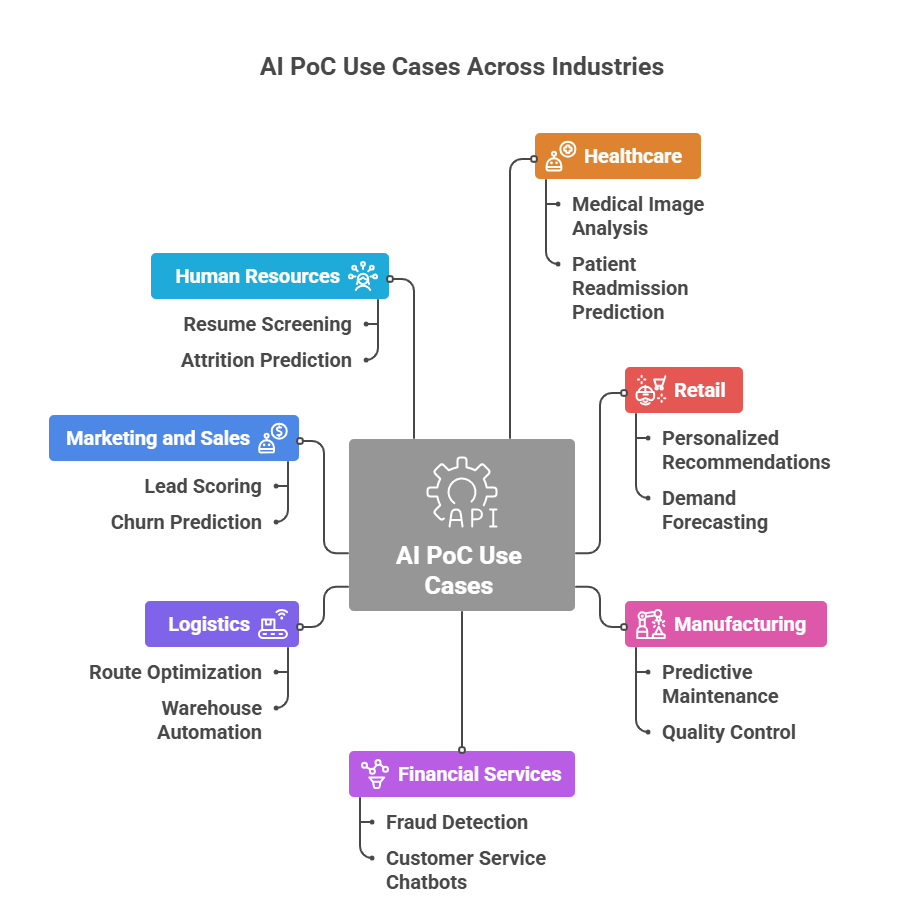
Healthcare: Transforming Patient Care
Medical Image Analysis: Healthcare providers pilot AI-powered diagnostic support as part of an AI PoC testing chest X-ray analysis with 500 images to compare AI findings against radiologist diagnoses. This validates faster preliminary screenings, reduced diagnostic errors, and optimized radiologist workload.
Patient Readmission Prediction: Hospitals analyze historical data from 1,000 discharged patients to predict 30-day readmission risk. Success enables targeted post-discharge interventions and reduced readmission penalties.
Retail: Enhancing Customer Experience
Personalized Recommendations: E-commerce companies deploy AI recommendations to 5% of website visitors, measuring conversion rate improvements against control groups. Successful pilots show increased average order value and higher conversion rates.
Demand Forecasting: Retail chains test AI predictions for 100 SKUs across 10 stores over three months. The PoC validates reduced stockouts, optimized inventory costs, and improved supply chain efficiency.
Manufacturing: Optimizing Production
Predictive Maintenance: Manufacturers pilot sensor-based AI monitoring of 10 critical machines to predict equipment failures. Success metrics include reduced unplanned downtime and optimized maintenance scheduling.
Quality Control: Production facilities test computer vision analyzing 1,000 product units daily on one production line for defect detection. The pilot validates faster identification, reduced waste, and consistent quality standards.
Financial Services: Improving Risk Management
Fraud Detection: Banks pilot AI analyzing 100,000 transactions monthly to identify suspicious patterns that traditional systems miss. Successful AI PoC use cases show reduced fraud losses and fewer false positives disrupting legitimate transactions.
Customer Service Chatbots: Financial institutions test AI chatbots handling 20% of incoming support requests, escalating complex issues to humans. Success demonstrates reduced costs, 24/7 availability, and improved customer satisfaction.
Logistics: Streamlining Operations
Route Optimization: Logistics companies pilot AI route planning for 20 delivery vehicles over one month. Results show reduced fuel costs, improved on-time delivery, and increased daily capacity.
Warehouse Automation: Distribution centers test AI optimizing picking routes in one warehouse zone. The PoC validates faster order fulfillment and reduced labor hours per order.
Marketing and Sales: Driving Revenue
Lead Scoring: Sales teams pilot AI models analyzing 6 months of historical lead data to predict conversion probability. Success shows improved sales efficiency and higher conversion rates through prioritization.
Churn Prediction: Subscription businesses analyze behavior patterns from 10,000 customers to identify churn risk. Validation enables proactive retention interventions and increased customer lifetime value.
Human Resources: Enhancing Talent Management
Resume Screening: HR departments pilot AI screening applications for 5 open positions, ranking candidates by qualification match. Results demonstrate reduced time-to-hire and improved candidate quality.
Attrition Prediction: Organizations analyze data from 500 employees to identify turnover risk factors. Success enables proactive retention strategies and reduced turnover costs.
Key Success Factors Across All AI PoC Use Cases
Clear Business Objectives: Successful AI PoC use cases initiative defines specific, measurable goals before development. Vague objectives like exploring AI rarely succeed.
Quality Data Availability: The PoC validates whether available data supports the intended AI application. Insufficient or poor-quality data surfaces early, preventing wasted full-scale investment.
Realistic Scope: Effective pilots focus on narrow, well-defined problems rather than comprehensive solutions. Limited scope enables faster validation and clearer results.
Stakeholder Alignment: Successful proofs of concept involve relevant stakeholders from inception, ensuring solutions address real needs and secure buy-in for production scaling.
Also Read : How AI Proof-of-Concept Reduce Engineering Risks
Implement AI That Delivers Results
These AI POC examples demonstrate how organizations across industries validate AI capabilities before major commitments. Whether you’re in healthcare, retail, manufacturing, finance, or logistics, starting with focused proof of concepts minimizes risk while maximizing learning.
At Amplework Software, we have guided organizations through successful AI business use cases and industry-specific pilots. Our AI custom development services tailor solutions to your business context and ensure you validate AI PoC efficiently before scaling to production.
 sales@amplework.com
 (+91) 9636-962-228