

Proof of Concept in AI Technologies: What It Is, Why It Matters & When to Use It
Introduction
You’re evaluating an AI investment that promises operational transformation. But how do you validate whether your AI idea will actually work with your specific data and business context before committing significant resources? The answer lies in a well-executed Proof of Concept in AI.
The reality is stark: only 48% of AI projects reach production, highlighting the importance of validation. Many initiatives fail before deployment, emphasizing why testing feasibility early with a PoC is critical for success.
What Is a Proof of Concept in AI?
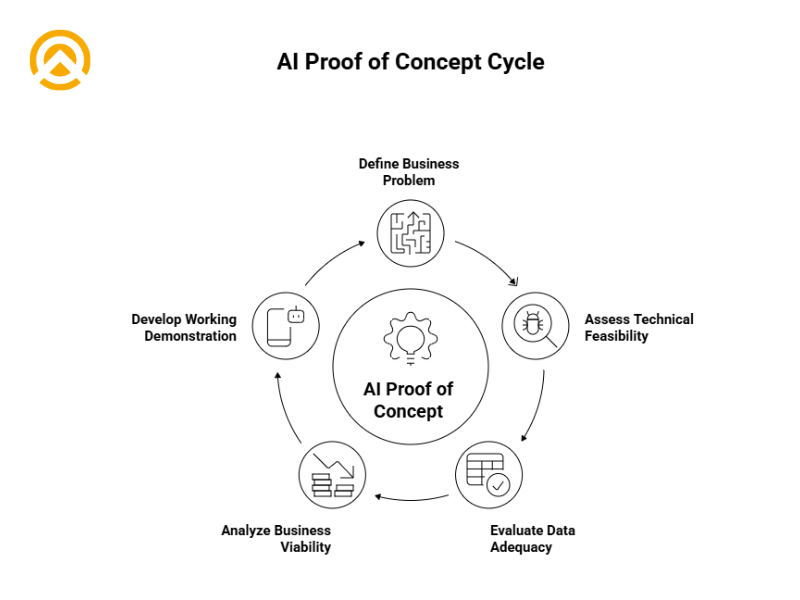
A Proof of Concept in AI is a small-scale experiment that validates whether artificial intelligence can solve your specific business problem with available resources. It tests three fundamental questions:
- Technical feasibility: Can AI address this problem?
- Data adequacy: Does our data support model training?
- Business viability: Will results justify investment?
A typical Proof of Concept in AI runs 4-8 weeks, uses limited data samples, and produces a working demonstration proving core functionality.
Why AI PoCs Matter
AI PoCs validate technical feasibility, showing whether machine learning can deliver the required accuracy with your data and constraints. They reduce financial risk, as only 48% of AI projects reach production, often taking eight months from prototype to deployment, helping organizations identify challenges early.
They also secure stakeholder buy-in by providing working demos with real data and concrete metrics that turn abstract proposals into compelling business cases. Through careful AI PoC development, organizations uncover data gaps, including quality issues, missing variables, and privacy concerns, and critical insights, since 92.7% of executives cite data as the biggest barrier to AI success.
AI PoC Use Cases: When to Use AI Proof of Concept
- Unproven Applications: Pioneering new AI approaches in healthcare diagnostics, legal analysis, or custom manufacturing optimization
- High-Stakes Systems: Credit approvals, medical diagnoses, safety systems requiring accuracy validation
- Uncertain Data Quality: Testing whether existing data supports model training
- Major Infrastructure Investment: Validating technical approaches before significant cloud computing or integration commitments
- Comparing Multiple Approaches: Testing traditional ML vs. deep learning with actual business data
Also Read : How ML Proof-of-Concept Projects Are Planned & Executed
When NOT to Use AI Proof of Concept
Understanding when to use AI PoC also means recognizing when to skip it:
- Well-established applications: Basic chatbots and email spam filtering have proven implementations
- Insufficient data availability: If you lack minimum data (1,000+ samples per category), address data collection first
- Unclear business objectives: Without clear success criteria, results remain ambiguous
Critical Success Components
- Define Measurable Criteria First: “Improve customer service” fails. “Reduce support ticket resolution time by 30%” succeeds.
- Use Real, Representative Data: Test with actual business data reflecting real-world messiness, not sanitized datasets masking challenges.
- Mirror Production Constraints: Similar latency requirements, integration complexity, and data access patterns.
- Document Everything Transparently: What works, what doesn’t, and why. “Failed” PoCs revealing fundamental issues save far more money than “successful” PoCs masking problems.
At Amplework Software, we guide organizations through AI PoCs across industries, using a structured process with clear success criteria, thorough data assessment, and working demonstrations via our AI development services.
Bottom Line
The AI PoC’s importance cannot be overstated: a well-executed Proof of Concept in AI validates technical feasibility, reduces risk, and provides evidence-based confidence for major investments. In an environment where 30% of generative AI projects will be abandoned after proof of concept, understanding when to use AI PoC and recognizing diverse AI PoC use cases separates successful implementations from expensive failures.
 sales@amplework.com
 (+91) 9636-962-228