
AI Model Training Services: What Businesses Actually Get (Workflow, Deliverables, & Expectations)
Introduction
When businesses invest in AI model training services, they often have unclear expectations about what they’ll actually receive. Is it just a trained model? What about documentation, ongoing support, or integration? Understanding the complete AI training workflow, tangible deliverables, and realistic expectations is crucial for making informed decisions and measuring ROI.
This guide demystifies the AI model development process, clarifying exactly what professional AI model training services deliver and what businesses should expect at each stage. Whether you’re exploring custom AI training for the first time or evaluating different service providers, this breakdown ensures you know what you’re paying for.
Understanding AI Model Training Services
AI model training services encompass the complete process of developing, training, testing, and deploying machine learning models tailored to specific business problems. Unlike off-the-shelf AI solutions, custom AI training creates models that understand your unique data, business context, and operational requirements.
Professional services include data preparation, algorithm selection, model training and optimization, validation, deployment infrastructure, and ongoing maintenance, not just delivering a “black box” algorithm. The goal is to provide production-ready AI systems that solve real business problems with measurable impact.
The Complete AI Training Workflow: Step-by-Step
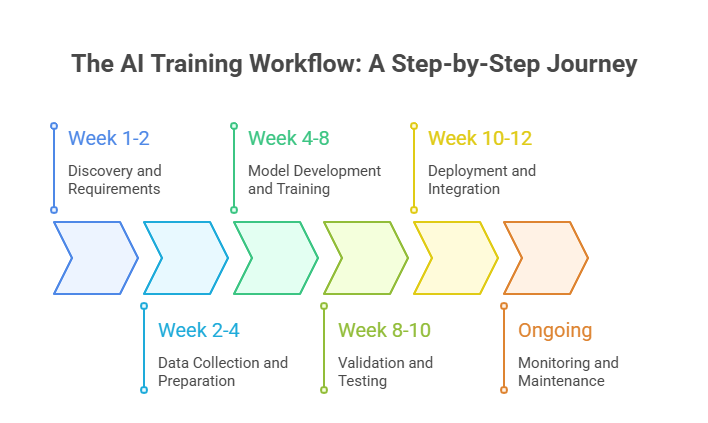
Phase 1: Discovery and Requirements (Week 1-2)
What Happens: Your service provider conducts detailed consultations to understand your business objectives, current challenges, and success metrics. They assess data availability, quality, and compliance requirements.
Deliverables:
- Business requirements document
- Technical feasibility assessment
- Project scope and timeline
- Cost estimation and ROI projections
Your Role: Provide access to relevant stakeholders, share existing data samples, and clarify business objectives and constraints.
Phase 2: Data Collection and Preparation (Week 2-4)
What Happens: The most time-intensive phase is where data scientists collect, clean, and transform raw data into training-ready datasets. This includes handling missing values, removing outliers, feature engineering, and data augmentation.
Deliverables:
- Cleaned and structured datasets
- Data quality report
- Feature engineering documentation
- Data pipeline architecture
Your Role: Grant access to data sources, validate data accuracy, and provide domain expertise for feature selection.
Phase 3: Model Development and Training (Week 4-8)
What Happens: Data scientists experiment with different algorithms, train multiple models, tune hyperparameters, and optimize for your specific success metrics (accuracy, speed, cost, etc.).
Deliverables:
- Trained model files
- Model architecture documentation
- Performance metrics report (accuracy, precision, recall, F1-score)
- Comparison of different model approaches
Your Role: Review preliminary results, provide feedback on priorities (speed vs. accuracy trade-offs), and participate in progress reviews.
Phase 4: Validation and Testing (Week 8-10)
What Happens: Rigorous testing on unseen data to validate model performance, identify edge cases, test for bias, and ensure reliability under various conditions.
Deliverables:
- Validation results report
- Edge case analysis
- Bias and fairness assessment
- Performance benchmarks against industry standards
Your Role: Provide real-world test scenarios, validate results against business logic, and identify any concerning patterns.
Phase 5: Deployment and Integration (Week 10-12)
What Happens: Models are deployed to production environments, integrated with existing systems, and configured for scalability. This includes setting up APIs, monitoring systems, and fail-safes.
Deliverables:
- Deployed model in production environment
- API documentation and integration guides
- Monitoring dashboards
- Scalability and performance optimization
Your Role: Provide access to production environments, coordinate with IT teams, and validate integration with existing workflows.
Phase 6: Monitoring and Maintenance (Ongoing)
What Happens: Continuous monitoring of model performance, retraining with new data, addressing model drift, and updating based on changing business needs.
Deliverables:
- Monthly performance reports
- Model retraining schedule and results
- Drift detection alerts
- Optimization recommendations
Your Role: Provide regular feedback, share new data, and communicate changes in business priorities.
Complete List of AI Training Deliverables
When you engage professional AI model training services, expect these tangible outputs:
Technical Assets:
- Trained model files (ready for deployment)
- Source code and training scripts
- Data preprocessing pipelines
- Model versioning and experiment tracking logs
Documentation:
- Technical specification document
- API documentation for model integration
- User guides for non-technical stakeholders
- Maintenance and retraining procedures
Performance Reports:
- Accuracy metrics and benchmarks
- Comparison with baseline approaches
- Cost-benefit analysis
- ROI projections based on actual performance
Infrastructure:
- Deployment architecture
- Monitoring and alerting systems
- Automated retraining pipelines
- Backup and rollback procedures
Knowledge Transfer:
- Training sessions for your team
- Best practices documentation
- Troubleshooting guides
- Access to ongoing support
Also Read : Generative AI in Medical Coding: Applications, Limitations, and Learning Benefits for Coders
Setting Realistic Expectations
Timeline: Most custom AI training projects take 8-16 weeks from kickoff to production deployment. Complex projects involving novel algorithms or large datasets may extend to 20+ weeks.
Accuracy: Professional models typically achieve 85-95% accuracy depending on problem complexity and data quality. 100% accuracy is rarely achievable or even desirable (risk of overfitting).
Cost: The total investment depends on factors such as data complexity, model sophistication, and deployment infrastructure. Planning for scalability and ongoing maintenance can affect overall costs.
Maintenance: AI models aren’t “set it and forget it” solutions. Budget 15-25% of initial development costs annually for monitoring, retraining, and optimization.
Business Impact: Results depend on use case, but typical benefits include 20-40% efficiency improvements, 15-30% cost reductions, or 10-25% revenue increases in targeted areas.
Common Pitfalls to Avoid
Be cautious of providers who:
- Promise unrealistic accuracy rates (99%+) without seeing your data
- Offer fixed deliverables without an initial data assessment
- Don’t include post-deployment support in their proposals
- Can’t explain their AI training workflow in business terms
- Don’t discuss model monitoring and maintenance
Maximizing Value from AI Model Training Services
- Prepare Quality Data: The better your input data, the better your results. Invest in data quality before training begins.
- Define Clear Success Metrics: Specify exactly how you’ll measure success; accuracy alone isn’t enough.
- Plan for Integration: Consider how the model will fit into existing workflows before development starts.
- Budget for Ongoing Costs: Factor in monitoring, retraining, and infrastructure costs beyond initial development.
- Invest in Knowledge Transfer: Ensure your team understands how to use, monitor, and troubleshoot the AI system.
Also Read : Choosing the Right AI Integration Platform: iPaaS, Custom Middleware, or Native AI?)
Conclusion
AI model training services deliver far more than just trained algorithms. From initial discovery through ongoing maintenance, professional services provide comprehensive solutions including data preparation, model development, deployment infrastructure, documentation, and continued support.
Amplework provides comprehensive enterprise solutions for AI model training, covering data preparation, model development, deployment, and ongoing support. Their services ensure scalable, reliable AI implementations that deliver measurable business impact while simplifying maintenance and monitoring.
 sales@amplework.com
 (+91) 9636-962-228