

Why 70% of AI Automation Projects Fail — and How to Architect for Success
Introduction
AI automation holds significant potential for enterprises, offering efficiency, cost savings, and faster decision-making. Yet, 70% of AI projects fail to reach production, often stalling after pilot or POC stages. These failures cost businesses time, resources, and stakeholder confidence, undermining AI transformation efforts. Many projects succeed technically but struggle operationally, facing challenges in integration, governance, and scalability. Understanding these root causes is essential for architects, leaders, and teams driving AI initiatives.
In this blog, we discuss common AI automation failures and strategies for designing scalable, successful enterprise AI systems.
Why AI Automation Projects Fail
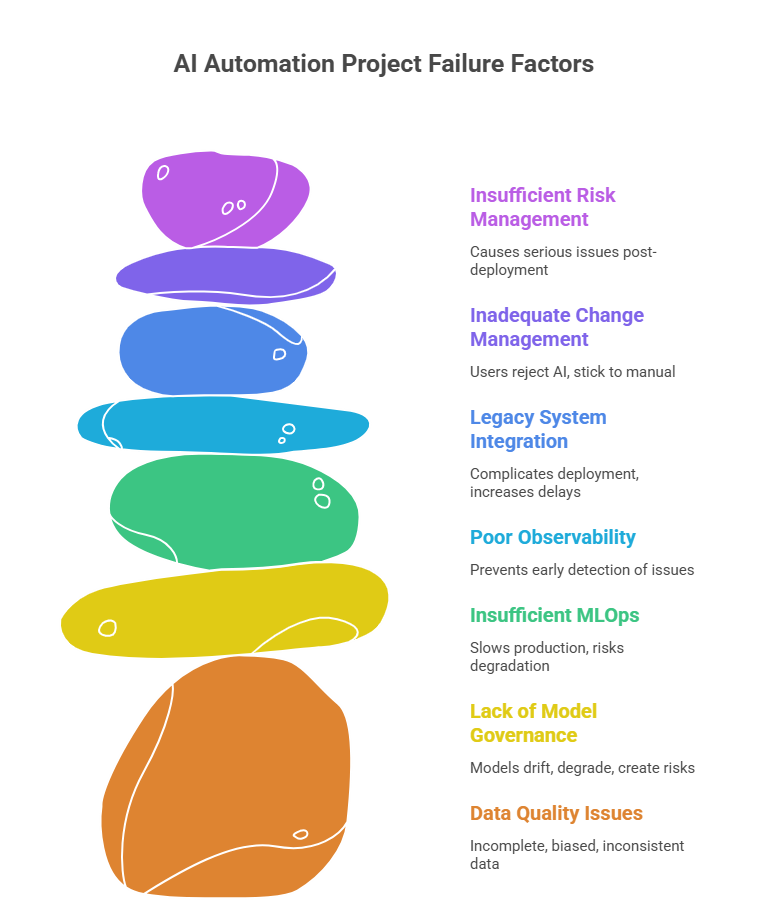
1. Data Quality Issues
AI automation failures are often caused by models trained on incomplete, biased, or inconsistent data, which leads to unreliable results. Ensure data quality with profiling, cleaning pipelines, and continuous monitoring. Allocate sufficient resources for data preparation to maximize AI performance.
2. Lack of Model Governance
Without proper governance, models drift, degrade, or create compliance risks. Implement versioning, documentation, approval workflows, and model registries to maintain control, monitor performance, and ensure operational and regulatory compliance.
3. Insufficient MLOps
Manual deployment and updates slow production and risk unnoticed performance degradation. Adopt MLOps platforms and CI/CD pipelines to automate deployment, retraining, rollback, and testing, ensuring models remain reliable and production-ready.
4. Poor Observability and Monitoring
Lack of real-time monitoring prevents early detection of bias, errors, or performance drops. Track model metrics, data drift, prediction distributions, and business outcomes, with alerts for deviations to enable proactive intervention.
5. AI Integration with Legacy Systems
Legacy infrastructure often lacks APIs and uses outdated protocols, complicating deployment. Prototype critical integrations early and design abstraction layers to simplify system connections, reduce implementation delays, and manage resources effectively.
6. Inadequate Change Management
Technical success can still lead to AI automation failures if users reject AI or stick to manual processes. Engage end users early, communicate AI as augmentation, provide training, and pilot systems gradually to ensure adoption and workflow integration.
7. Insufficient AI Risk Management
Unmanaged AI risks, bias, privacy, security, and compliance can cause serious issues post-deployment. Conduct early risk assessments, implement safeguards, and maintain continuous monitoring to mitigate potential harms before they impact the business.
Architecting for Success: Building Scalable AI Systems
1. Start with Enterprise AI Strategy
AI automation best practices begin with a comprehensive enterprise AI strategy aligning initiatives with business objectives, establishes governance frameworks, and prioritizes high-value use cases.
Key Elements: Executive sponsorship, cross-functional teams, clear ROI metrics, phased rollout plans, and sustained commitment beyond POC approval.
2. Design Scalable AI Architecture
Scalable AI architecture anticipates growth from POC through enterprise-wide deployment. AI system architecture decisions made during POC determine whether systems handle production scale or require expensive rebuilds.
Architecture Principles:
- Microservices enabling independent model scaling
- API-first design simplifying integration
- Cloud-native infrastructure supporting elastic scaling
- Separation of training and inference pipelines
- Modular components enabling iterative enhancement
3. Address AI Scalability Issues Proactively
AI scalability issues emerge when systems handling hundreds of requests daily must support millions. Performance, cost, and reliability challenges requiring architectural changes appear.
Scalability Planning: Test at realistic scales during POC. Identify bottlenecks early. Design for 10x expected load. Implement caching, load balancing, and horizontal scaling from day one.
4. Optimize for AI Project ROI
AI project ROI demands measuring business impact, not just technical metrics. Failed projects often lack clear value propositions or don’t track outcomes stakeholders care about.
ROI Framework: Define success metrics upfront, cost savings, revenue increases, and efficiency gains. Track continuously. Adjust implementations based on business impact, not technical elegance.
5. Implement Continuous Improvement
Enterprise AI implementation requires treating deployment as a beginning, not an end. Successful organizations continuously monitor performance, gather feedback, and enhance systems based on real-world learning.
Improvement Cycle: Monitor → Analyze → Optimize → Deploy → Repeat. Allocate 15-25% of the initial AI model development budget for ongoing optimization.
Also Read : Revolutionize Your Workflow: How AI Automation Software is Redefining Business Efficiency
The AI Project Success Factors
Organizations achieving the 30% success rate share common characteristics:
- Executive Commitment: Sustained leadership support beyond initial enthusiasm.
- Realistic Expectations: Understanding AI limitations alongside capabilities
- Quality Data: Investment in data infrastructure and governance
- Cross-Functional Teams: Collaboration spanning technical and business domains.
- Phased Rollouts: Gradual expansion proving value incrementally
- Continuous Learning: Adaptation based on production experience
Conclusion
AI automation failures often occur due to data quality, governance, scalability, and operational challenges. Success requires strategic planning, robust architecture, cross-functional collaboration, and continuous monitoring. Partnering with experienced teams can help ensure AI initiatives deliver measurable enterprise impact.
Amplework provides end-to-end AI development services, including scalable architecture, MLOps, model governance, and legacy system integration, helping enterprises move AI projects efficiently from POC to production while minimizing risk and maximizing ROI.
 sales@amplework.com
 (+91) 9636-962-228