
AI Agent Orchestration for Cross-Functional Process Automation
Introduction
Most business processes do not operate within a single department. A customer order covers multiple functions, including sales, finance, operations, and logistics. Similarly, new employee onboarding involves HR, IT, facilities, and management. These cross-functional workflows are where organizations struggle most with automation, as they require coordination across systems, teams, and decision points that have traditionally operated independently.
AI agent orchestration addresses this challenge by coordinating specialized agents across departmental boundaries, enabling end-to-end automation that previously depended on extensive human coordination.
What is AI Agent Orchestration
AI agent orchestration is the coordination layer that manages how multiple specialized AI agents work together to complete complex, multi-step workflows. Rather than allowing agents to operate in isolation, orchestration provides centralized control that determines task order, enables information sharing between agents, and ensures exceptions or failures are handled correctly.
Think of AI agent orchestration as a project manager overseeing a large cross-functional project. Each AI agent acts as a specialist: one gathers information, another analyzes data, another makes decisions, and another executes actions. Without a project manager, these specialists may work in parallel but lack alignment, leading to delays or errors. Orchestration ensures each agent performs its role at the right time, with the right inputs, and in coordination with others to achieve a single, unified outcome.
The Cross-Functional Challenge
Traditional automation approaches fail at cross-functional processes because they optimize individual steps without addressing the handoffs between them. Sales automates quote generation, operations automates fulfillment, but the transition between them still requires manual coordination. Each department implements its own systems without considering how they connect.
This creates multiple problems:
- Handoff bottlenecks: Work sits in queues waiting for the next department to pick it up
- Information loss: Critical context gets lost in translation between systems
- Error propagation: Mistakes at one stage compound across departments before detection
- Velocity constraints: Process speed is limited by handoff delays, not task completion
- Accountability gaps: No single owner for end-to-end outcomes when processes span departments
How Orchestration Enables Cross-Functional Automation
Orchestration coordinates specialized agents representing different functions to execute complete workflows automatically. Rather than each department running its own agents, orchestration manages how agents work together throughout the process.
For customer onboarding, orchestration coordinates agents handling credit checks, account setup, compliance screening, welcome communications, and system provisioning. These agents operate on different systems managed by different teams, but orchestration ensures they execute in the right sequence, share necessary information, and handle exceptions appropriately.
The key is that orchestration treats the cross-functional workflow as a single coordinated process rather than a collection of departmental tasks. It manages dependencies, routes information between agents, and maintains process state from start to finish.
Real-World Applications
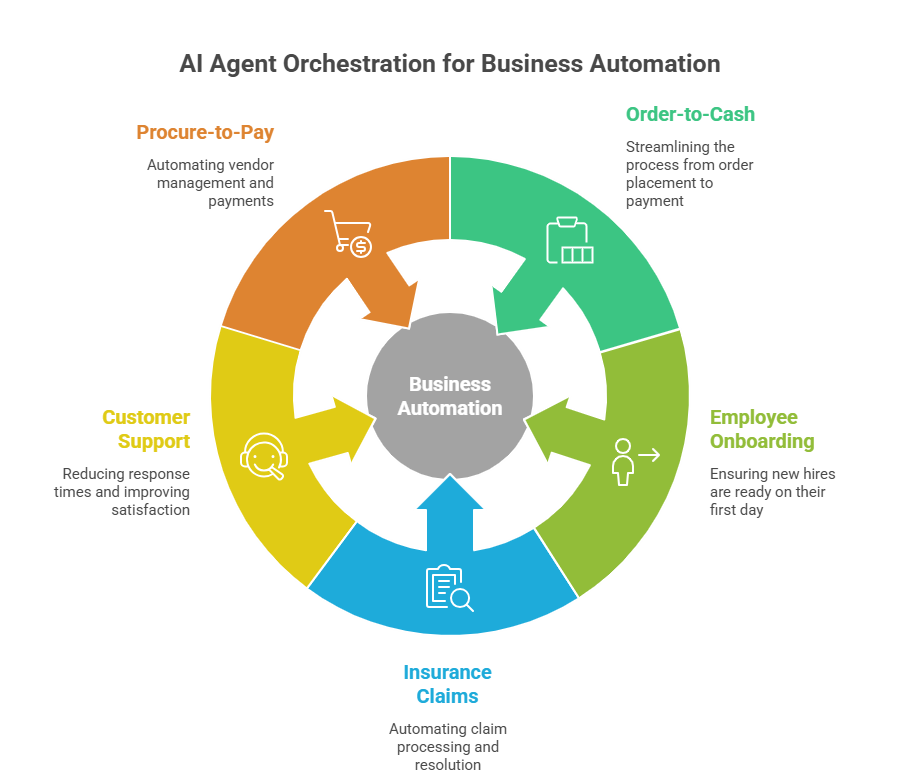
AI agent orchestration enables organizations to automate complex, cross-functional workflows by coordinating specialized agents across systems and teams.
1. Order-to-Cash
A manufacturing firm orchestrated agents across sales, credit, operations, and finance, reducing order processing from days to hours and increasing capacity 4× without additional staff.
2. Employee Onboarding
A technology company coordinated HR, IT, facilities, and training systems, improving first-day readiness from 60% to 95% and reducing HR workload by 40%.
3. Insurance Claims
An insurer automated intake, verification, assessment, fraud checks, and payments, cutting claim resolution time from 10 days to 2 days.
4. Customer Support Resolution
A SaaS company orchestrated ticket handling, diagnostics, billing, and engineering, reducing first-response time by 70% without growing support teams.
5. Procure-to-Pay
An enterprise automated vendor validation, approvals, compliance checks, and payments, shrinking procurement cycles from weeks to days.
Also Read : Understanding Large Language Models (LLMs)
Implementation Considerations
Organizations implementing cross-functional orchestration should address several critical factors:
- Start with high-frequency processes where delays cause visible pain: Customer onboarding, order processing, and support escalations make excellent starting points because orchestration delivers immediate, measurable value.
- Map the complete workflow before automating: Understand every step, decision point, and handoff across departments. AI Automation works only when the process is clearly defined and agreed upon by all stakeholders.
- Establish clear ownership: Cross-functional processes need process owners with authority spanning departments. Without this, orchestration becomes a technical solution to a political problem.
- Build feedback loops: When orchestration automates cross-functional workflows, monitor performance across the entire process, not just individual steps. Optimize for end-to-end outcomes rather than departmental efficiency.
The Strategic Advantage
Organizations that successfully orchestrate cross-functional processes gain advantages that competitors struggle to replicate:
- Dramatic Process Velocity: Work flows automatically across departmental boundaries without manual handoffs, reducing cycle times by 50-70%
- Superior Customer Experience: Processes complete faster with fewer errors, improving satisfaction and retention
- Lower Operational Costs: Automation eliminates manual coordination overhead, reducing administrative expenses by 30-50%
- Organizational Scalability: Handle volume increases without proportional headcount growth across multiple departments
- Compounding Capability: Each process automated makes the next easier through shared infrastructure and common patterns
Also Read : Understanding Large Language Models (LLMs)
Partner with Amplework
Amplework delivers AI agent development services focused on orchestrating agents across cross-functional processes. We help organizations identify high-impact use cases, design efficient multi-agent workflows, and implement reliable orchestration and governance frameworks. Whether starting with a single process or scaling enterprise-wide automation, Amplework provides the expertise needed to build, coordinate, and manage AI agents effectively.
Conclusion
AI agent orchestration transforms cross-functional processes from organizational weak points into competitive strengths. By coordinating specialized agents across departments, orchestration automates workflows that previously resisted automation because of their distributed nature.
The organizations mastering cross-functional orchestration are processing orders faster, onboarding customers more smoothly, and handling operations more efficiently than those still coordinating these processes manually. The advantage compounds as more processes become orchestrated and organizational capability grows.
Cross-functional processes are where orchestration delivers maximum value. Start there, prove the capability, and expand systematically across the enterprise.
 sales@amplework.com
 (+91) 9636-962-228