
What Are Natural Language Understanding (NLU) Solutions? Simple Examples
Introduction
Businesses are increasingly relying on AI to enhance customer interactions and operational efficiency. Natural Language Understanding (NLU) allows systems to accurately capture intent and context, transforming automated processes into reliable, high-quality support. With the NLU market expected to reach $62.9 billion by 2029, companies that leverage this technology gain measurable improvements in productivity and service quality. This blog explains NLU solutions, differences from NLP, key capabilities, industry use cases, challenges, and implementation strategies for businesses.
What Are NLU Solutions?
Natural Language Understanding solutions are AI systems that comprehend human language’s meaning, intent, and context, not just individual words. NLU goes beyond recognizing text to actually understanding what users mean, what they want, and how to respond appropriately.
When a customer says, “My order hasn’t arrived yet,” NLU solutions understand:
- Intent: The customer wants order status information
- Entity: There’s a specific order being referenced
- Sentiment: The customer is concerned or frustrated
- Action Required: Check shipping status and provide updates
This deep comprehension enables automated systems to respond intelligently rather than mechanically.
NLU vs NLP: Understanding the Difference
Natural Language Processing (NLP) is the broad field covering all computational language tasks, including text analysis, translation, speech recognition, and text generation. NLP manipulates language but doesn’t necessarily understand it.
Natural Language Understanding (NLU) is a specialized subset of NLP focused on comprehension, determining meaning, intent, and context from language input. Think of it this way: NLP reads words on a page; NLU understands what those words actually mean and why they were used.
Example Comparison:
- NLP Task: Identifying that the word “server” appears in the sentence “The server is down.”
- NLU Task: Determining whether “server” refers to a web server, database server, or a person serving requests, based on context.
NLU enables machines to grasp nuance, ambiguity, and implicit meaning that pure text processing misses, making it critical for accurate automation, intelligent customer interactions, and data-driven decision-making.
Key Capabilities of Effective NLU Solutions
- Multi-Language Support: Understanding intent across languages and dialects is critical for global businesses.
- Domain Customization: Pre-trained models fine-tuned for industry-specific terminology (legal, medical, financial, technical).
- Continuous Learning: Systems improve accuracy over time by learning from corrections and new examples.
- Context Awareness: Maintaining conversation state across multiple exchanges for coherent interactions.
- Ambiguity Resolution: Handling unclear inputs by asking clarifying questions rather than guessing incorrectly.
Real-World NLU Use Cases Across Industries
1. Customer Support Automation
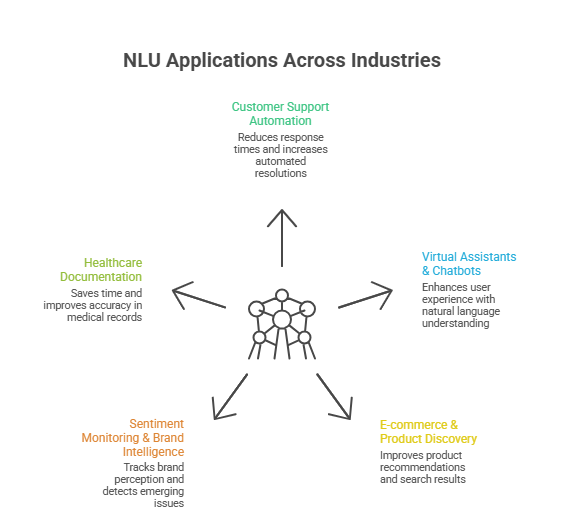
- Challenge: Support teams handle thousands of inquiries daily across email, chat, and social media.
- NLU Solution: Intent detection automatically categorizes inquiries (billing, technical issues, account changes) and routes them to the right teams or provides automated responses.
- Impact: A telecom company implemented NLU through AI agent development, reducing response times from 4 hours to 30 seconds and increasing automated resolution.
2. Virtual Assistants & Chatbots
- Challenge: Basic chatbots respond to keywords rather than true user intent, frustrating users.
- NLU Solution: Intelligent assistants comprehend natural language, handle follow-up questions, and manage multi-turn conversations.
- Impact: A healthcare provider deployed NLU-powered appointment scheduling, enabling patients to book, confirm, and receive reminders automatically based on natural language requests.
3. E-commerce & Product Discovery
- Challenge: Traditional keyword search often misses customer intent, making product discovery difficult.
- NLU Solution: Understanding shopping intent improves recommendations and search results through AI Automation Services.
- Impact: A fashion retailer used NLU to understand queries, recommending relevant ski gear like jackets, thermal wear, and waterproof items automatically.
4. Sentiment Monitoring & Brand Intelligence
- Challenge: Companies need to analyze thousands of reviews, social posts, and feedback to gauge customer sentiment.
- NLU Solution: Systems analyze tone, emotion, and opinion to track brand perception and detect emerging issues.
- Impact: A software company monitors feedback with NLU, identifying frustrated users before they churn. Early intervention via AI consulting services reduced cancellations by 23%.
5. Healthcare Documentation
- Challenge: Physicians spend excessive time on administrative documentation, reducing patient care focus.
- NLU Solution: Medical NLU systems extract relevant information from clinical conversations and generate structured electronic health records automatically.
- Impact: Doctors dictate naturally, and NLU captures symptoms, diagnoses, medications, and treatment plans in structured records, saving time and improving accuracy.
Implementing NLU in Your Organization
1. Start with High-Value Use Cases: Focus on areas where understanding intent delivers immediate ROI, such as customer support, internal search, and appointment scheduling.
2. Collect Quality Training Data: Gather examples of real user language from your domain, ensuring NLU models capture specific terminology and patterns.
3. Leverage AI Model Training: Use structured AI model training to teach systems how to interpret intent accurately and adapt to new scenarios.
4. Plan for Continuous Improvement: Establish feedback loops where human reviewers correct errors, allowing the system to learn and improve over time.
5. Balance Automation with Human Escalation: Ensure systems recognize uncertainty and route complex cases to human agents for seamless handling.
Challenges in Natural Language Understanding
- Cultural Nuances: Idioms, references, and expressions vary across cultures and may confuse NLU systems.
- Evolving Language: Slang, new terminology, and changing usage patterns require constant model updates.
- Complex Queries: Multi-part questions with conditional logic challenge even advanced NLU systems.
- Privacy Concerns: Processing sensitive conversations requires robust data protection and compliance measures.
Also Read : How to Set Up an AI Translation PoC: Beginner-Friendly Process, Tools & Testing Tips
Conclusion
NLU solutions transform how businesses interact with customers and process information by comprehending intent, context, and meaning, not just words. From customer support automation to intelligent search, NLU enables machines to understand human communication as naturally as humans do, creating experiences that feel helpful rather than robotic. Leveraging AI automation services from Amplework can accelerate NLU adoption, enabling businesses to implement intelligent systems quickly, optimize workflows, and deliver superior customer experiences at scale.
 sales@amplework.com
 (+91) 9636-962-228