

AI Contextual Accuracy: Improving Precision in Enterprise AI
Introduction
Enterprise AI deployments often struggle with a critical problem: models produce confidently incorrect outputs that seem plausible but contain factual errors, misunderstand context, or generate inappropriate responses. These AI accuracy challenges create serious business risks when systems provide customer-facing answers, generate reports, or support decision-making. Organizations need AI they can trust, not systems requiring constant human verification.
Improving AI contextual accuracy requires understanding why models make mistakes and implementing proven techniques addressing root causes. Context-aware AI systems that understand domain-specific knowledge, business logic, and situational nuances deliver the precision enterprises need. This guide explores practical approaches for enhancing contextual AI accuracy in production business environments.
Understanding AI Accuracy Challenges
- Context Problem: AI models often lack company-specific context, terminology, and business rules, leading to incorrect or irrelevant responses when addressing organization-specific topics.
- Hallucination: AI may generate fabricated information, citing non-existent sources or inventing facts, posing risks for enterprise use.
- Terminology Confusion: General AI struggles with industry jargon, acronyms, and brand or product names, causing misinterpretation.
- Outdated Information: AI cannot access the latest company data or real-time updates, limiting practical utility in enterprises.
- Ambiguity Misinterpretation: AI may misread complex or ambiguous queries, producing inaccurate, misleading, or irrelevant outputs without explicit guidance.
Proven Techniques for Improving Enterprise AI Contextual Accuracy
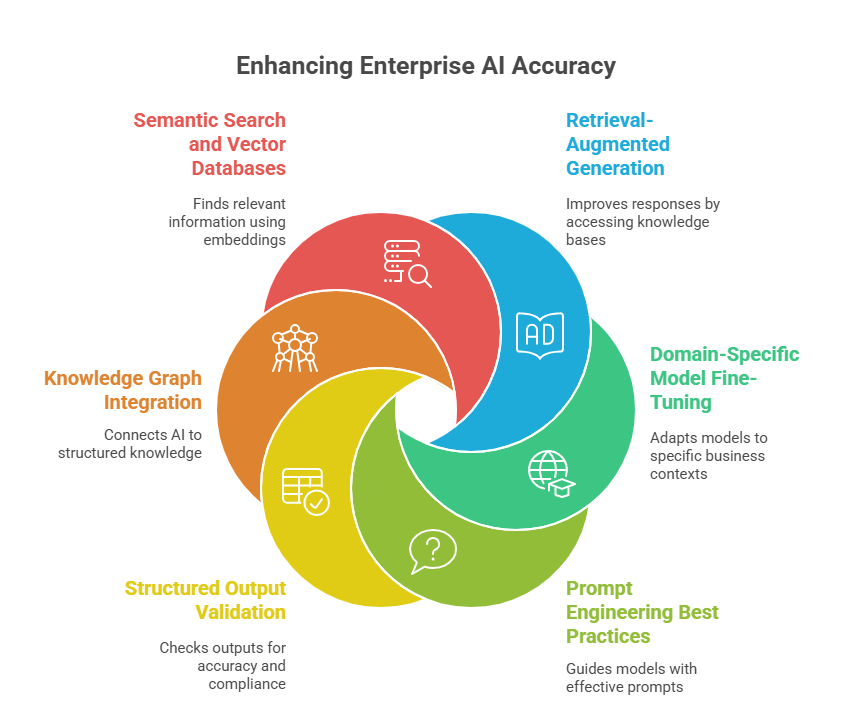
1. Retrieval-Augmented Generation (RAG)
RAG enhances AI responses by retrieving relevant information from your knowledge bases before generating answers. Instead of relying solely on training data, models access current, accurate company information dynamically. This retrieval-augmented generation approach dramatically improves factual accuracy and reduces hallucinations.
RAG implementation benefits:
- Grounds responses in actual company data
- Provides access to current information
- Reduces hallucination rates significantly
- Enables citation of specific sources
- Allows knowledge base updates without retraining
RAG represents the most effective technique for improving enterprise NLP accuracy in production systems.
2. Domain-Specific Model Fine-Tuning
AI model fine-tuning adapts general models to your specific domain, terminology, and use cases. Fine-tuning on company documents, support tickets, or domain literature teaches models your context, improving accuracy on business-specific queries.
Fine-tuning approaches:
- Training on internal documents and communications
- Supervised learning on labeled examples
- Continuous learning from user corrections
- Domain adaptation transfer learning
- Task-specific optimization
Fine-tuned models understand your business context better than generic alternatives but require quality training data.
3. Prompt Engineering Best Practices
Sophisticated prompts dramatically improve output quality by providing context, examples, constraints, and clear instructions. Well-engineered prompts guide models toward accurate responses while prompt engineering best practices reduce ambiguity and misinterpretation.
Effective prompting techniques:
- Provide relevant context explicitly
- Include a few-shot example demonstrating desired outputs
- Specify output format and constraints clearly
- Break complex queries into simpler steps
- Request citations and reasoning chains
Advanced prompting improves accuracy without model modification or additional infrastructure.
4. Structured Output Validation
Implement validation layers checking AI outputs for accuracy, appropriateness, and policy compliance before reaching users. Validation catches errors that slip through other defenses, providing critical safety nets.
Validation approaches include:
- Fact-checking against authoritative sources
- Consistency verification across responses
- Policy and compliance rule checking
- Confidence score thresholding
- Human-in-the-loop review for critical outputs
Validation adds reliability to AI precision improvement strategies, ensuring quality control.
5. Knowledge Graph Integration
Connect AI systems to structured knowledge graphs encoding relationships, facts, and business rules explicitly. Knowledge graphs provide definitive information grounding AI responses in verifiable facts rather than probabilistic guesses.
Knowledge graph benefits:
- Explicit relationship and fact encoding
- Logical reasoning support
- Contradiction detection
- Version-controlled knowledge management
- Auditable information sources
Knowledge graphs complement neural approaches, providing structured reasoning capabilities.
6. Semantic Search and Vector Databases
Advanced search using semantic embeddings finds relevant information even when exact keywords don’t match. Vector databases enable efficient similarity search across large document collections, providing context for AI responses.
Semantic search advantages:
- Intent-based rather than keyword matching
- Multilingual retrieval capability
- Conceptual similarity understanding
- Scalable across large knowledge bases
- Fast retrieval for real-time applications
Quality retrieval directly impacts context-aware AI systems’ accuracy and relevance.
Enterprise Implementation Strategy
1. Start with High-Value, Controlled Use Cases
Begin AI contextual accuracy improvements in contained environments where errors have limited consequences. Customer support assistants suggesting responses for agent review present a lower risk than fully autonomous customer-facing systems.
2. Implement Graduated Autonomy
Use confidence thresholding to route uncertain queries to human review. High-confidence responses proceed automatically, while edge cases receive human oversight. This graduated approach balances automation benefits with quality control.
3. Establish Clear Escalation Paths
Design systems recognizing their limitations and escalating appropriately. AI admitting uncertainty proves more valuable than confidently incorrect responses.
4. Monitor and Measure Continuously
Track accuracy metrics, user satisfaction, correction rates, and error patterns. Continuous monitoring enables proactive quality management rather than reactive problem-solving.
5. Plan for Ongoing Maintenance
AI contextual accuracy requires continuous attention, knowledge base updates, model retraining, prompt refinement, and validation rule updates. Budget for sustained operations, not just initial AI model deployment.
Also Read : How to Choose the Best AI Development Company for Healthcare Applications
Benefits of Improving Contextual Accuracy in Enterprise AI:
- Better Decision-Making: AI outputs are relevant and aligned with business context, supporting more informed decisions.
- Increased Efficiency: Reduces the need for manual corrections and clarifications, saving time and resources.
- Enhanced Customer Experience: Responses are tailored and meaningful, improving user satisfaction and engagement.
- Reduced Risk of Errors: Minimizes inaccuracies, hallucinations, or irrelevant information in AI outputs.
- Higher Adoption of AI Solutions: Reliable, precise AI encourages wider organizational use and trust.
Also Read : AI/ML Expert Hiring Challenges & Solutions for 2026
Final Words
AI contextual accuracy determines whether enterprise AI delivers value or creates risks. Generic models lack business context, producing unreliable outputs unsuitable for critical applications. Implementing proven techniques, RAG, fine-tuning, advanced prompting, validation, and quality data transforms unreliable AI into trusted business systems.
Amplework applies expertise in context-driven AI strategies, guiding organizations to improve accuracy, validate outputs, and implement reliable enterprise AI solutions. By prioritizing AI contextual accuracy, businesses can confidently deploy AI, ensuring precision, trust, and measurable value instead of relying on generic models.
 sales@amplework.com
 (+91) 9636-962-228