

AI/ML Expert Hiring Challenges & Solutions for 2026
Introduction
The demand for AI and machine learning talent has exploded while the supply of qualified professionals remains critically low. Companies across industries compete fiercely for the same limited pool of experienced AI engineers, data scientists, and ML specialists. This AI/ML hiring challenges crisis delays projects, inflates salaries, and forces organizations to compromise on talent quality or project timelines.
The ML talent shortage isn’t improving; it’s intensifying as AI adoption accelerates across every sector. Understanding current hiring challenges and practical solutions helps organizations build AI capabilities despite competitive talent markets. The companies that adapt their hiring strategies succeed while others struggle indefinitely with unfilled positions and stalled AI initiatives.
Major AI/ML Hiring Challenges in 2026
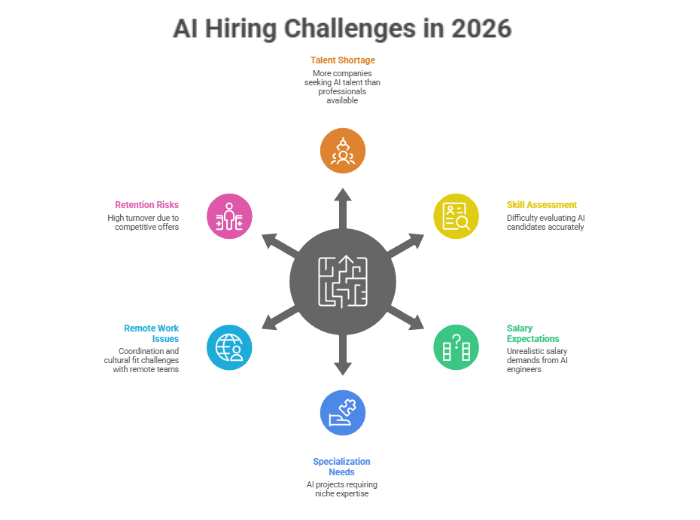
1. Severe Talent Shortage and Competition
There are far more companies seeking AI talent than qualified professionals available. This imbalance drives long hiring cycles, rising salaries, multiple competing offers, geographic limitations, and retention difficulties, making traditional hiring approaches largely ineffective in 2026.
2. Difficulty Assessing Technical Skills
Evaluating AI candidates accurately is challenging. Résumés often overstate expertise, portfolios vary, and HR teams lack technical depth. Misjudging capabilities leads to expensive mis-hires, wasted time, and disrupted projects, emphasizing the need for thorough technical assessment processes.
3. Unrealistic Salary Expectations
Top AI engineers demand premium compensation, often including additional equity or benefits. Smaller companies struggle to compete with tech giants, facing budget constraints and geographic salary variations, which limit their ability to attract and retain top talent.
4. Narrow Specialization Requirements
AI projects frequently require niche expertise such as NLP, computer vision, or reinforcement learning. Finding candidates with domain-specific experience, technology stack alignment, and industry knowledge is difficult, often forcing companies to extend hiring timelines indefinitely.
5. Remote Work Complications
Remote work increases talent access but introduces coordination, cultural fit, onboarding, and collaboration challenges. Organizations must balance geographic flexibility with practical requirements while addressing legal and compliance complexities to manage distributed teams effectively.
6. Retention and Competitive Hiring Risks
Retaining AI talent is difficult due to constant recruiter outreach, competing offers, and career opportunities elsewhere. Organizations risk losing employees within 12–18 months, causing high turnover that wastes recruiting investment and disrupts ongoing projects.
Practical Solutions for AI/ML Hiring Challenges
1. Expand Geographic Search Through Remote Work
Embrace fully remote or hybrid models, accessing talent beyond local markets. This dramatically expands candidate pools while often reducing compensation requirements compared to major tech hub salaries.
2. Implement Rigorous Technical Assessments
Develop comprehensive technical evaluation processes, including coding challenges, system design discussions, and practical problem-solving exercises. Partner with technical advisors if internal expertise is limited.
3. Consider AI Staff Augmentation
Rather than hiring permanent employees, use AI staff augmentation by accessing pre-vetted AI/ML specialists quickly. This approach provides flexibility, reduces hiring timelines, and minimizes long-term commitment risks.
4. Build Internal Training Programs
Upskill existing technical staff into AI/ML roles through structured training programs. This develops loyal employees with organizational knowledge rather than competing for external talent.
5. Partner with AI Consulting Firms
Engage consulting firms providing complete AI teams rather than individual hires. Consultants deliver immediate expertise while you build internal capabilities gradually.
6. Offer Compelling Non-Monetary Benefits
When salary competition is difficult, emphasize interesting problems, cutting-edge technology, flexible work arrangements, professional development, and meaningful impact, attracting talent beyond compensation alone.
Also Read : Hiring an AI Automation Freelancer for System Integration: Benefits, Risks & Best Practices
How to Hire AI Engineers Effectively
- Define Requirements Clearly: Specify actual project needs versus idealized wish lists. Distinguish must-have skills from nice-to-haves, enabling broader candidate consideration.
- Streamline Interview Processes: Lengthy hiring processes lose candidates to faster-moving competitors. Compress timelines without sacrificing quality assessment.
- Leverage Professional Networks: Tap employee referrals, professional communities, and industry connections, finding candidates not actively job searching.
- Consider Contract-to-Hire: Test working relationships through contract engagements before permanent commitments. This reduces hiring risk while providing evaluation periods.
- Emphasize Growth Opportunities: Highlight learning opportunities, interesting challenges, and career advancement potential attracting ambitious engineers.
The Amplework AI Talent Solutions
At Amplework Software, we solve AI/ML hiring challenges through comprehensive staffing solutions, providing immediate access to pre-vetted AI talent. Our AI consulting services eliminate lengthy hiring cycles, salary negotiations, and retention risks.
Our AI Talent Solutions:
- Pre-vetted AI/ML specialists available immediately
- Flexible engagement models (contract, part-time, full-time)
- Specialized expertise across AI domains
- Managed teams with built-in redundancy
- Scalable capacity matching project needs
We maintain a global network of experienced AI engineers, data scientists, and ML specialists ready to integrate into your projects quickly. Our rigorous vetting process ensures technical capabilities, while our managed approach handles all employment complexities.
Also Read : When to Hire Reinforcement Learning Developers for AI Projects
Final Words
AI/ML hiring challenges won’t disappear in 2026; talent competition will intensify as AI adoption accelerates. Organizations that adapt hiring strategies, embrace flexible staffing models, and leverage external expertise succeed while those relying on traditional approaches struggle indefinitely.
The question isn’t whether to change hiring approaches but how quickly you adapt. Companies accessing AI talent through alternative models gain competitive advantages while others wait months for traditional hires that may never materialize.
 sales@amplework.com
 (+91) 9636-962-228