
AI Prototyping: Turning Ideas Into Functional Models
Introduction
Many AI projects fail because organizations skip validation and jump directly from concepts to full-scale development. They invest months and significant budgets in building systems that ultimately don’t solve intended problems or meet user needs. This expensive approach leads to disappointment, wasted resources, and skepticism about AI’s value.
AI prototyping offers a faster and more cost-effective path from ideas to functional validation. Prototypes test core concepts quickly, reveal technical challenges early, and demonstrate value to stakeholders before major investment. Understanding the AI prototyping process helps organizations validate ideas efficiently while minimizing risks and costs associated with unproven AI initiatives.
What Is AI Prototyping?
AI prototyping focuses on creating lightweight yet functional versions of AI systems that showcase essential capabilities without the refinement required for production. These early models help teams assess technical feasibility, observe how users interact with the system, and evaluate potential business impact through practical experimentation.
Unlike proof-of-concept that address isolated technical questions, prototypes deliver interactive demonstrations that stakeholders can actively test. This approach helps organizations determine whether the solution is workable and valuable before investing in full-scale development.
The AI Prototyping Process
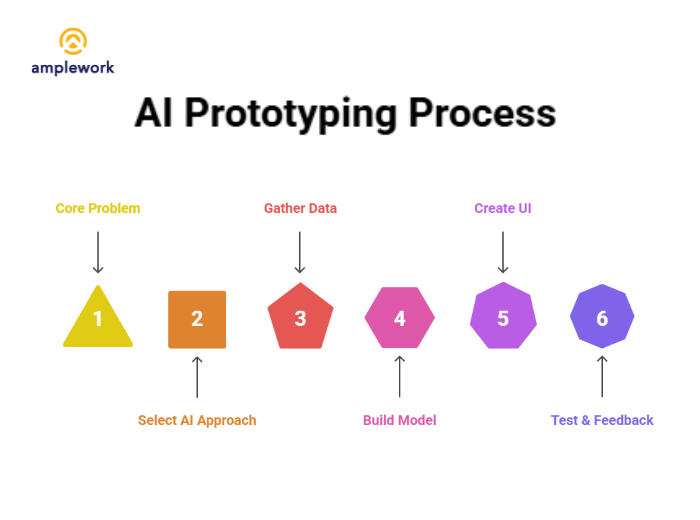
Step 1: Define Core Problem and Success Criteria
Start by clearly articulating the specific problem your AI will solve and how success will be measured. Vague goals produce unfocused prototypes that don’t answer critical questions. Define exact functionality to test and metrics proving value.
Problem definition includes:
- Specific use case identification
- Target user definition
- Success metric establishment
- Constraint documentation
- Scope boundary setting
Clear objectives guide prototype design and enable objective evaluation.
Step 2: Select Appropriate AI Approach
Choose AI techniques matching your problem type, supervised learning for predictions, NLP for text processing, and computer vision for images. Research similar solutions and select approaches with proven success in comparable applications.
Approach selection considers:
- Problem type alignment
- Data availability matching
- Complexity appropriateness
- Technical feasibility
- Implementation timeline
The right approach selection dramatically improves prototype success likelihood.
Step 3: Gather and Prepare Sample Data
Collect representative data samples for prototype training and testing. Quality matters more than quantity in prototypes; small, clean datasets suffice for validation. Prepare data through cleaning, labeling, and formatting for the chosen AI approach.
Data preparation includes:
- Sample data collection
- Quality assessment and cleaning
- Labeling or annotation
- Format standardization
- Test set separation
Good data preparation determines the prototype performance ceiling.
Step 4: Build Minimal Functional Model
Develop the simplest AI model demonstrating core functionality. Use pre-trained models, transfer learning, and existing frameworks to accelerate development. Focus on proving the concept works rather than optimizing performance.
Model building involves:
- Framework and tool selection
- Pre-trained model utilization
- Basic training implementation
- Initial performance testing
- Quick iteration cycles
Speed matters more than perfection in prototype development.
Step 5: Create a Simple User Interface
Build basic interfaces allowing stakeholders to interact with prototypes. These don’t need production polish; simple web forms, command-line tools, or basic apps suffice for demonstrating functionality and gathering feedback.
Interface development includes:
- Input method creation
- Result display design
- Basic error handling
- User flow implementation
- Feedback collection mechanisms
Interfaces make abstract AI tangible for non-technical stakeholders.
Step 6: Test and Gather Feedback
Have target users interact with prototypes, observing usage patterns and collecting feedback. Test with realistic scenarios revealing strengths, weaknesses, and unexpected issues. This feedback guides decisions about full development.
Testing activities include:
- User interaction observation
- Feedback collection
- Performance measurement
- Edge case identification
- Usability assessment
Real user testing reveals insights internal teams miss.
Step 7: Evaluate and Decide Next Steps
Analyze prototype performance against success criteria. Determine whether the core concept is validated, what improvements are needed, or if fundamental approach changes are required. Make informed go/no-go decisions about full AI model development.
Evaluation deliverables:
- Performance against criteria
- User feedback summary
- Technical feasibility assessment
- Cost and timeline estimates
- Recommendation for next steps
Objective evaluation enables confident investment decisions.
AI Prototype Examples Across Industries
- Healthcare Diagnosis Assistant: Prototype analyzing patient symptoms, suggesting potential diagnoses. Tests if AI can match a doctor’s accuracy on specific condition types.
- Customer Support Chatbot: Basic conversational agent answering common questions. Validates if AI understands user intent and provides helpful responses.
- Predictive Maintenance System: Model predicting equipment failures based on sensor data. Demonstrates whether AI identifies failure patterns early enough for preventive action.
- Document Processing Automation: Prototype extracting information from invoices or contracts. Tests accuracy of data extraction for specific document types.
- Personalized Recommendation Engine: A simple system suggesting products based on user behavior. Validates if recommendations improve engagement and conversion.
Also Read : How NLP Consulting Helps Companies Automate Text-Based Workflows
How to Build an AI Prototype Successfully
- Start Simple: Begin with minimal viable functionality. Add complexity only after proving basic concepts work.
- Use Existing Tools: Leverage pre-trained models, established frameworks, and existing tools rather than building everything from scratch.
- Focus on Core Questions: Design prototypes answering specific validation questions rather than demonstrating every possible feature.
- Involve Users Early: Get prototypes in front of actual users quickly. Their feedback proves more valuable than internal opinions.
- Accept Imperfection: Prototypes validate concepts, not demonstrate production quality. Rough edges are acceptable and expected.
- Document Learnings: Record insights, challenges, and lessons learned, informing full development if prototypes succeed.
Final Words
AI prototyping transforms uncertain ideas into validated concepts through rapid, cost-effective experimentation. Prototypes answer critical questions about feasibility, value, and user acceptance before major investments, dramatically improving AI project success rates.Amplework Software delivers rapid AI prototyping to validate ideas, reduce development risk, and guide next steps, seamlessly transitioning successful prototypes into production-ready systems when you hire AI developers from our experienced AI development teams.
 sales@amplework.com
 (+91) 9636-962-228