

AI System Integration: How Businesses Connect AI With Existing Tech Stacks
Introduction
Modern businesses face a critical challenge: integrating artificial intelligence into their existing technology infrastructure without disrupting daily operations. In this blog, we explore how AI system integration has become essential for companies looking to leverage machine learning, automation, and intelligent decision-making while maintaining their current workflows. Successful integration allows organizations to enhance efficiency, reduce errors, and gain actionable insights from the data already flowing through their systems.
Rather than replacing legacy systems, enterprises are increasingly finding ways to augment their current tech stacks with AI-powered features. In this blog, we also discuss the key approaches, technologies, and best practices that ensure AI works seamlessly with existing systems.
Understanding AI System Integration
AI system integration involves connecting artificial intelligence capabilities with your existing software, databases, and business processes. Rather than replacing entire systems, companies are finding ways to enhance their current tech stacks with AI-powered features that add value without requiring complete overhauls.
The goal is seamless communication between AI models and legacy systems, ensuring data flows smoothly and intelligence is applied where it matters most.
Key Approaches and Technologies for AI Integration
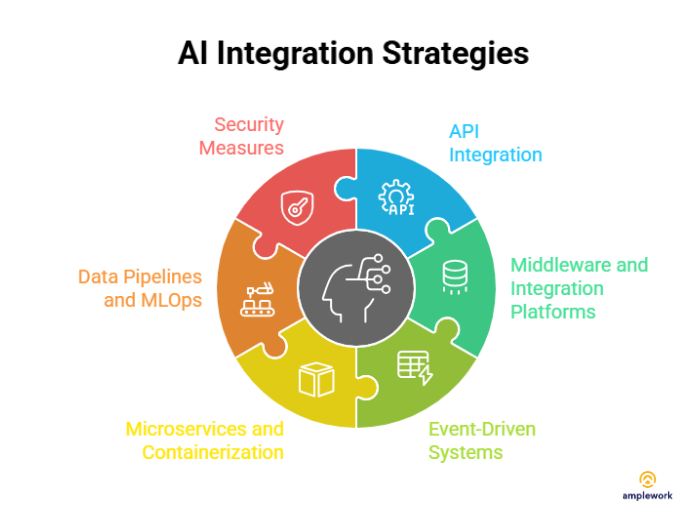
Integrating AI with existing enterprise systems requires effective approaches and technologies to ensure smooth, reliable, and scalable operations.
1. API Integration
REST, GraphQL, and gRPC APIs enable AI models to communicate with CRMs, ERPs, and legacy systems without rewriting existing code.
2. Middleware and Integration Platforms
Platforms like MuleSoft, and AWS AppFlow manage data routing, transformation, and compatibility between AI models and enterprise applications.
3. Event-Driven Systems
Tools such as Kafka and EventBridge provide real-time triggers, supporting use cases like predictive maintenance and automated ticket handling.
4. Microservices and Containerization
Docker, Kubernetes, and microservices allow scalable, version-controlled AI model deployments without affecting existing workflows.
5. Data Pipelines and MLOps
ETL pipelines, lakehouse platforms, and frameworks like MLflow and Kubeflow ensure clean data flow, model monitoring, and smooth updates.
6. Security Measures
Role-based access, encryption, and secure APIs protect enterprise data while maintaining compliance.
Best Practices for System Integration With AI
Follow these guidelines for successful and effective implementation:
1. Start with Clear Use Cases
Identify specific business problems where AI delivers measurable value, clearly define desired outcomes, and align objectives to ensure focused, efficient, and impactful integration efforts.
2. Choose Appropriate Solutions
Select AI integration solutions that fully align with your existing technical environment, infrastructure, and business requirements for seamless connectivity, smooth deployment, and maximum operational efficiency.
3. Leverage Expertise
Hire skilled AI developers who understand both AI capabilities and enterprise architecture to ensure smooth deployment, reliable performance, and efficient system integration across all workflows.
4. Test Thoroughly
Conduct pilot programs and staged rollouts before full deployment to detect potential issues, optimize system behavior, and confirm AI models perform effectively in real conditions.
5. Document Everything
Maintain comprehensive documentation of integration points, data flows, dependencies, and configurations to simplify troubleshooting, future updates, and continuous optimization of AI-enabled systems.
6. Monitor Continuously
Track system performance, accuracy, and overall business impact on an ongoing basis to detect anomalies early, maintain consistent effectiveness, and ensure reliable AI system operations.
Also Read : How to Integrate AI into Your Existing Systems and Stay Competitive
Benefits of AI System Integration
Integrating AI with existing tech stacks offers multiple advantages that directly impact business efficiency and decision-making:
- Enhanced Operational Efficiency: AI automates repetitive tasks, streamlines workflows, and reduces manual effort for higher-value employee focus.
- Data-Driven Decision Making: Connected AI models analyze real-time data, delivering actionable insights for better planning and forecasting.
- Cost Reduction: Automation and optimized workflows reduce operational costs, minimize errors, and improve overall resource utilization efficiency.
- Improved Customer Experience: AI features like chatbots, personalized recommendations, and predictive support enhance engagement across multiple channels.
Conclusion
AI system integration is essential for businesses aiming for efficiency, agility, and intelligence. By connecting AI with existing systems, companies enable automation, predictive insights, and improved customer experiences. Using APIs, middleware, event-driven systems, microservices, MLOps, and strong security ensures scalable, sustainable, and optimized operations.Amplework offers comprehensive AI integration services, helping enterprises seamlessly connect AI with existing tech stacks. Their expert AI developers ensure smooth deployment, continuous optimization, and measurable business outcomes.
 sales@amplework.com
 (+91) 9636-962-228