
When to Hire Reinforcement Learning Developers for AI Projects
Introduction
Reinforcement learning is a powerful yet underused area of artificial intelligence. Many companies rely on supervised learning but miss opportunities where RL performs better. When you hire reinforcement learning developers, you gain expertise in sequential decision-making, complex optimization, and interactive learning, enabling AI systems to discover optimal strategies that extend beyond traditional machine learning methods.
Understanding Reinforcement Learning
Reinforcement learning differs fundamentally from supervised and unsupervised learning. RL agents learn by interacting with environments, receiving rewards or penalties based on the actions they take. Through repeated interactions, agents discover optimal strategies maximizing long-term rewards. This approach mirrors how humans learn through experience and feedback.
When Your AI Project Needs Reinforcement Learning
1. Sequential Decision-Making Problems
You need RL when your project involves making a series of interconnected decisions where each choice affects future options and outcomes. Traditional ML models predict single outcomes, but RL optimizes entire decision sequences. This applies to robotics, game playing, resource allocation, and dynamic pricing scenarios.
Sequential decision applications:
- Autonomous vehicle navigation systems
- Multi-step manufacturing processes
- Supply chain optimization workflows
- Dynamic inventory management
- Strategic game AI development
2. Optimization Without Clear Rules
Your problem lacks explicit rules or formulas defining optimal behavior. You know the desired outcome but not the precise steps to achieve it. RL algorithms enable AI model optimization by discovering effective strategies through experimentation, making them ideal when expert knowledge is incomplete or unavailable.
Rule-free optimization includes:
- Trading strategy development
- Energy grid management
- Traffic flow optimization
- Resource allocation in cloud computing
- Portfolio rebalancing automation
3. Real-Time Adaptive Systems
Your AI must continuously adapt to changing conditions and learn from ongoing interactions. Static models trained once become outdated quickly. RL systems improve through deployment, adapting strategies as environments evolve without constant retraining from scratch.
Adaptive system needs:
- Personalized recommendation engines
- Dynamic pricing algorithms
- Adaptive network routing
- Real-time bidding systems
- Conversational AI improvements
4. Robotics and Control Systems
You’re developing systems requiring precise control in physical or simulated environments. RL excels at learning motor control, manipulation tasks, and coordination. These developers understand how to bridge simulation and reality, training robots efficiently before deployment.
Robotics applications include:
- Robotic arm manipulation tasks
- Drone navigation and control
- Warehouse automation systems
- Manufacturing assembly optimization
- Autonomous mobile robots
5. Game AI and Simulation
Your project involves complex strategic gameplay or simulation environments with multiple agents and objectives. RL has revolutionized game AI, creating systems that master complex games through self-play. This extends beyond entertainment to business simulations and training scenarios.
Game and simulation uses:
- Strategic game opponent AI
- Multi-agent coordination systems
- Business strategy simulators
- Training environment development
- Competitive scenario planning
Signs You’re Ready to Hire RL Developers
- Complex Decision Chains: Your problem involves multiple sequential decisions with delayed consequences that compound over time.
- Insufficient Training Data: You lack labeled examples for supervised learning, but can define success criteria through reward signals.
- Dynamic Environments: Your system operates in conditions that change unpredictably, requiring continuous adaptation.
- Optimization Goals: You seek to maximize long-term outcomes rather than predict specific values or classifications.
- Existing Infrastructure: You have simulation capabilities or environments where RL agents can train safely before production deployment.
Essential RL Engineer Skills to Look For
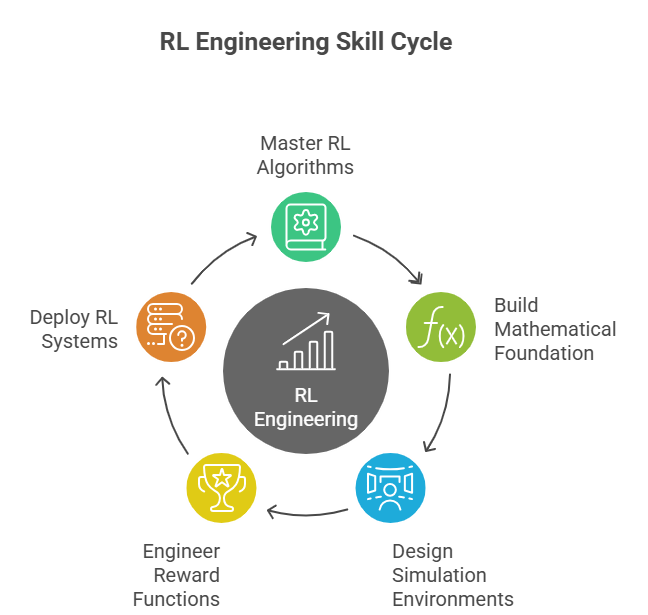
Deep Understanding of RL Algorithms
Developers must master RL algorithms, choose correct methods, and build custom solutions using frameworks like Stable Baselines or Ray RLlib.
Mathematical Foundation
Strong knowledge of probability, optimization, dynamic programming, and MDPs helps developers design rewards and debug complex learning behaviors effectively.
Simulation Environment Design
Skilled ML developers create efficient training environments, apply domain randomization, and ensure smooth transfer from simulation to real-world systems.
Reward Engineering Expertise
Experts design reward functions that guide correct behavior, avoid unintended actions, and prevent reward hacking or loophole exploitation.
Production Deployment Experience
Developers must understand serving, monitoring, safety controls, and deploying RL systems that manage exploration safely in live environments.
Also Read : Reasoning in Agentic AI: How Modern LLM Agents Make Decisions
Steps to Hire Reinforcement Learning Developers
1. Define Your RL Requirement
Determine whether your problem genuinely needs reinforcement learning for sequential decision optimization.
2. Identify Required Skills
List technical skills including algorithms, simulations, reward design, deployment, and optimization expertise.
3. Evaluate Developer Experience
Review practical projects demonstrating real reinforcement learning applications across simulations and robotics.
4. Assess Problem Solving
Test how developers design rewards, tune policies, and handle iterative experimental learning.
5. Ensure Production Readiness
Confirm experience deploying reinforcement learning systems with monitoring, controls, and fallback mechanisms.
Also Read : How to Select the Best NLP Development Company for Your Project
Conclusion
Reinforcement learning excels in solving complex, sequential decision problems. When you hire reinforcement learning developers, you gain expertise in algorithms, mathematics, and production deployment. Amplework Software’s AI development services provide end-to-end RL development, turning challenging optimization problems into real business value.
 sales@amplework.com
 (+91) 9636-962-228