
AI PoC Development Services: How Companies Build AI Prototypes With High Success Rates
Introduction
Artificial intelligence is transforming industries, but not every idea is ready for full-scale development from day one. This is why companies rely on AI PoC development services to validate concepts, test feasibility, and identify risks early. A well-executed Proof of Concept helps organizations understand what is technically possible, what challenges may arise, and what value they can realistically expect from an AI solution. When done right, an AI PoC significantly increases the chances of a successful deployment.
In this blog, we explore how companies build high-success-rate AI prototypes, what steps are involved, and why the right PoC approach can make or break your AI investment.
Why AI PoC Development Matters
AI projects often fail due to unclear scope, poor data quality, or misaligned expectations. AI proof of concept serves as a safety layer, giving businesses a controlled environment to test assumptions. It helps you evaluate:
- Technical feasibility
- Expected accuracy and performance
- Data readiness and complexity
- Business value and ROI potential
Instead of committing to a full AI system, organizations get a working prototype that demonstrates whether the idea is worth scaling. This reduces cost, accelerates learning, and removes uncertainty.
Core Components of High-Success-Rate AI PoCs
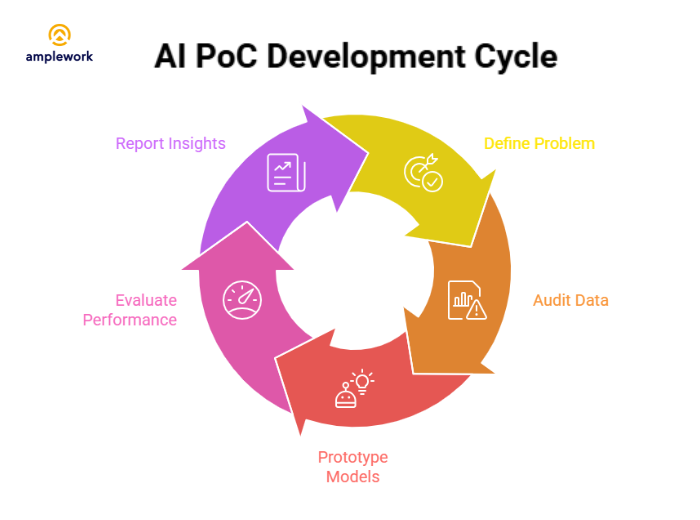
Successful AI PoCs follow a structured development process. The companies leading in this space follow five key stages:
1. Problem Definition With Business Alignment
The first step is clarifying what the PoC must achieve. Companies define the problem in measurable terms:
- What business challenge are we addressing?
- What outcome will prove success?
- How will the solution integrate later?
Clear objectives ensure the PoC stays focused and avoids scope creep.
2. Data Audit and Feasibility Assessment
Most AI projects fail because the data is incomplete, inaccessible, or unstructured. High-performing AI teams begin with a detailed data readiness check:
- Data availability
- Data volume and variety
- Data quality and labeling needs
- Privacy and compliance constraints
This audit allows teams to identify gaps early and avoid delays.
3. Rapid Prototyping With Lean AI Models
To validate concepts quickly, companies use lightweight versions of AI models, such as:
- NLP models for text analysis
- Computer vision models for image processing
- Predictive models for forecasting
- Recommendation engines
The goal is not perfection but functionality. A quick prototype shows whether the idea works and how much improvement is possible.
4. Evaluation With Clear KPIs
The PoC is then tested using predefined metrics such as:
- Model accuracy
- Precision and recall
- Latency and response time
- User experience
- Business value indicators
Companies compare actual results with initial expectations to determine whether the solution is viable.
5. Insight Report and Scalability Roadmap
Once testing is complete, AI teams prepare a detailed report that covers:
- Technical findings
- Success score based on KPIs
- Identified risks and limitations
- Infrastructure requirements
- Projected ROI
- Roadmap for full-scale deployment
This final document is critical for decision-making and budget approvals.
Best Practices Used by Leading AI PoC Teams
Companies that achieve high success rates follow certain proven practices:
Start Small, Expand Gradually
Rather than attempting complex automation immediately, they test one capability at a time. Small wins build confidence and reduce risk.
Use Real Data, Not Synthetic Samples
Testing with real business data ensures accurate results and exposes real-world challenges.
Collaborate Closely With Stakeholders
Domain knowledge from business teams helps refine model assumptions and interpret results correctly.
Leverage Reusable Components
Top AI engineering teams use pre-built pipelines, reusable code blocks, and modular architectures. This accelerates development and reduces effort in future iterations.
Document Every Step
Proper documentation prevents confusion later and simplifies compliance, especially in industries like healthcare, finance, and insurance.
Benefits of Investing in AI PoC Development Services
Organizations that embrace PoC-first strategies get several advantages:
- Reduced Cost and Risk: You reduce unnecessary spending by validating AI viability early before committing to full systems.
- Faster Time to Market: Teams accelerate delivery by prioritizing essential features that bring rapid and meaningful improvements today.
- Better Decision Making: Clear evidence enables leaders to confidently choose whether to scale, enhance, or stop initiatives.
- Higher ROI: Validated AI initiatives secure stronger returns by ensuring resources fund only proven strategic opportunities.
Also Read : AI Proof of Concept Use Cases: Practical Business Examples Across Industries
Conclusion
AI PoC development services help organizations test ideas, identify risks, and validate value before investing heavily. Amplework enhances this process with its structured approach and proven expertise as a trusted AI development agency. By combining disciplined scoping, data readiness checks, rapid prototyping, and clear evaluation metrics, companies increase their chances of building successful AI products. A well-executed Proof of Concept not only proves feasibility but also lays the foundation for a scalable, high-quality AI solution that accelerates business transformation.
 sales@amplework.com
 (+91) 9636-962-228