
How to Hire ML Developers & Data Scientists Together: Building High-Performance AI Teams
Introduction
Organizations often hire ML developers and data scientists as if their roles are interchangeable, or bring them in one after another. This leads to friction, misalignment, and stalled AI initiatives.
Research shows that 87% of data science projects never reach production because data scientists focus on research while ML engineers focus on deployment. The solution is building complementary teams where both roles collaborate from day one to deliver real business value.
Understanding the Roles: ML Engineer vs Data Scientist Hiring
Data Scientists: The Explorers
Data scientists focus on extracting insights, building experimental models, and answering business questions through data analysis.
Core Responsibilities:
- Exploratory data analysis and hypothesis testing
- Statistical modeling and experimentation
- Feature discovery and business insight generation
- Research-oriented model prototyping
- Communication of findings to stakeholders
ML Developers/Engineers: The Builders
ML developers transform data science experiments into scalable, production-ready systems.
Core Responsibilities:
- Production model deployment and optimization
- ML pipeline architecture and automation
- Model monitoring and performance management
- Integration with existing software systems
- Scalability and reliability engineering
Why Hiring Them Together Matters
Hiring ML developers and data scientists together closes the research-to-production gap by aligning model design and deployment from the start. It prevents rework caused by sequential hiring and reduces friction. Integrated teams share goals, move faster, and cut rework by nearly sixty percent, making unified hiring far more effective.
Building Your ML Team Structure
1. Optimal Team Composition Ratios
The ideal ML team structure depends on your organization’s maturity and objectives:
| Organization Stage | Data Scientists | ML Engineers | Data Engineers | Reasoning |
| Early Stage (MVP) | 1-2 | 1 | 0-1 | Focus on proving value quickly |
| Growth Stage | 2-3 | 2-3 | 1-2 | Scaling proven concepts |
| Mature Stage | 3-5 | 4-6 | 2-4 | Multiple production systems |
| Enterprise | 5+ | 8+ | 4+ | Complex ML infrastructure |
2. Essential Supporting Roles
Beyond core DS and ML roles, consider:
- Data Engineers: Build and maintain data infrastructure that both data scientists and ML developers depend on.
- MLOps Engineers: Specialize in AI automation, monitoring, and lifecycle management as teams scale.
- Domain Experts: Provide business context that guides both research and engineering decisions.
Strategic Hiring Approaches
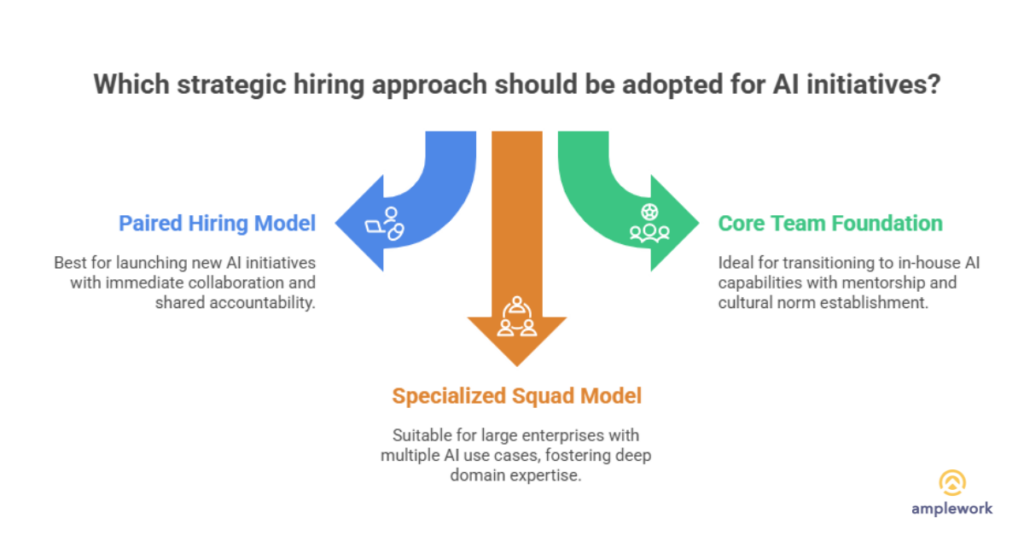
Approach 1: The Paired Hiring Model
Hire DS-ML pairs simultaneously for specific projects or use cases.
Advantages:
- Immediate collaboration from project inception
- Shared accountability for outcomes
- Natural knowledge transfer
- Faster time-to-production
Best For: Organizations launching new AI initiatives or product features.
Approach 2: The Core Team Foundation
Build a small, versatile core team (2 data scientists + 2 ML engineers) before expanding.
Advantages:
- Establishes cultural norms and workflows
- Creates a mentorship structure for future hires
- Validates hiring criteria through real projects
- Builds institutional knowledge
Best For: Companies transitioning from outsourced AI to in-house capabilities.
Approach 3: The Specialized Squad Model
Create cross-functional squads with dedicated DS, ML, and data engineering resources per business domain.
Advantages:
- Deep domain expertise development
- Clear ownership and accountability
- Reduced coordination overhead
- Faster decision-making
Best For: Large enterprises with multiple AI use cases across departments.
Key Hiring Considerations for ML & DS Collaboration
1. Assess Collaboration Skills
Technical brilliance means little without collaborative capability. During interviews:
Evaluation Techniques:
- Present scenarios requiring DS-ML coordination
- Ask candidates to describe past collaboration challenges
- Assess communication clarity with non-technical audiences
- Evaluate openness to feedback and iteration
2. Evaluate Technical Overlap
The best DS-ML partnerships have complementary skill overlap:
Ideal Skill Distribution:
- Data scientists with basic deployment knowledge
- ML engineers with a statistical understanding
- Both are comfortable with Python and common ML frameworks
- Shared understanding of data engineering fundamentals
3. Cultural Fit and Mindset Alignment
Critical Attributes:
- Pragmatism over perfectionism: Both roles must balance quality with delivery
- Business outcome orientation: Technical excellence serves business goals
- Continuous learning: AI evolves rapidly; curiosity is essential
Common Hiring Mistakes to Avoid
Mistake 1: Hiring Data Scientists Without Deployment Support
Creates a backlog of unused models where excellent research never reaches real users.
Mistake 2: Prioritizing ML Engineers Before Establishing Use Cases
Results in sophisticated infrastructure with no clear business application.
Mistake 3: Expecting Unicorns
Individuals excelling at both research and production engineering are rare and expensive. Build complementary teams instead.
Also Read : Why Companies Hire Remote Machine Learning Engineers in 2026
Building vs. Partnering: The Resource Reality
Building AI teams demands long hiring cycles, extensive onboarding, and months to reach productivity, along with significant management effort, collaboration processes, and infrastructure investment, making internal team creation slow and resource-heavy.
Accelerate Your AI Team Building
Successful hiring of ML developers and data scientists requires deep expertise, mature processes, and a strong collaborative culture. Amplework Software provides complete AI teams, proven DS ML frameworks, robust Data Engineering support, and strategic AI consulting services to eliminate hiring risk, accelerate value, and deliver production-ready AI solutions.
 sales@amplework.com
 (+91) 9636-962-228